PR analytics for enterprise engineering orgs: complete 2026 guide
PR analytics for enterprise engineering organizations: use merged GitHub history to document delivery, prepare reviews, and avoid misleading productivity scores.

Enterprise engineering organizations’ PR analytics is the analysis of pull request activity to understand delivery history and document engineering work. This 2026 guide explains how to use PR analytics for enterprise engineering organizations without confusing a developer’s merged GitHub history with a team-wide productivity measure.
Why PR analytics matters for enterprise engineering organizations
Enterprise developers need evidence that survives changes in projects, repositories, and review periods. A performance-review draft that says you improved reliability needs supporting work: the relevant pull requests, your contribution, and an outcome you can substantiate. A merged PR provides a reference point, not the whole explanation.
Organization-wide reporting asks a different question. An engineering manager investigating review delays needs information about the review process, including work that has not merged. A developer assembling a personal delivery history needs a narrower record. Choose the reporting question before choosing the dashboard.
The distinction matters when evaluating engineering metrics tools for engineering managers. Personal summaries and organization-wide process reporting have different requirements; neither should silently stand in for the other.
For your 2026 review, start with evidence you can inspect. Keep repository context attached to each contribution, distinguish your authored work from review work, and avoid turning activity counts into claims about business impact.
Build a useful PR analytics workflow
Start manually so you understand the underlying records. GitHub search and a simple document are enough to establish the scope and identify what deserves a summary. Add a tool only when repeatedly searching and regrouping the same history becomes the work itself.
The following steps serve individual developers working inside enterprise engineering organizations. They also establish boundaries that a manager can use when deciding whether a personal reporting workflow is sufficient or a separate organization-wide analysis is required.
Define the reporting question
Write down what you need to answer before collecting pull requests. Preparing a self-review is not the same task as investigating a team’s review process. A self-review asks what you delivered and why it mattered; process analysis asks where work waited and what affected its movement.
Choose a period that matches the decision. A 1-month window supports a monthly recap, a 3-month window supports a quarterly review, and a 12-month window supports an annual delivery history. These are reporting choices, not performance benchmarks. Use the same boundaries when comparing your own periods.
For a 2026 performance review, make the reporting period explicit in the document title or opening sentence. Readers should not need to infer whether your summary covers a calendar year, a project, or your time on a particular team.
- State the question in one sentence.
- Set the start and end dates.
- Identify the reader: yourself, your manager, or an interviewer.
- Separate delivery evidence from process investigation.
- Record what the report deliberately excludes.
Find your merged pull requests in GitHub
Use GitHub search for the first pass. The qualifiers is:pr is:merged author:@me identify merged pull requests authored by the signed-in user. Add a merge-date filter to select the period, then narrow the search to the organization or repository you need.
For example, is:pr is:merged author:@me merged:2026-01-01..2026-01-31 searches your authored pull requests merged during January 2026. This uses the merge date, not the date you opened the PR. That distinction matters when work crosses a reporting boundary.
An organization filter narrows the search scope; it does not grant access to repositories. Search results reflect the repositories your account can access. If you need a record from somewhere you cannot access, resolve that through the organization’s approved process rather than treating an empty result as proof that no work occurred.
- Filter for pull requests rather than issues.
- Filter for merged status.
- Filter for your author identity.
- Apply the reporting period to the merge date.
- Narrow by organization or repository.
Replace repetitive personal searching when needed
Keep using manual GitHub searches for an occasional lookup. Save the search text and maintain a short working document. This keeps the collection method visible and lets you check whether the records actually answer your reporting question before adopting another tool.
When the same searches recur, Pulltally provides a web tool for individual developers to browse and summarize merged GitHub pull requests by month, organization, or personal repository. Pulltally is best for individual developers who need merged GitHub PR history for performance reviews or job searches.
Pulltally’s PR analytics scope is personal delivery history, not a productivity score. Its limitation for an enterprise-wide reporting brief is that the stated scope concerns individual developers’ merged history, not organization-wide review queues or team performance comparisons. Keep those requirements separate instead of expecting a personal summary to answer them.
- Use manual search for isolated questions.
- Identify searches you repeat across reporting periods.
- Browse merged history by the grouping you need.
- Check individual records before including them in a review.
- Keep enterprise process analysis outside a personal-history report.
Check the scope before writing a summary
A result list needs a scope check before it becomes evidence. Confirm that the merge dates match your period and that the repositories belong in the report. A personal repository, an internal service, and an open-source contribution can all be relevant, but they should not be combined without explanation.
Use the same sequence for each reporting period: find merged PRs, check the scope, add context, and write the summary. This separates retrieving records from interpreting them. For your 2026 review, keep the original references alongside the prose so you can revisit any statement later.
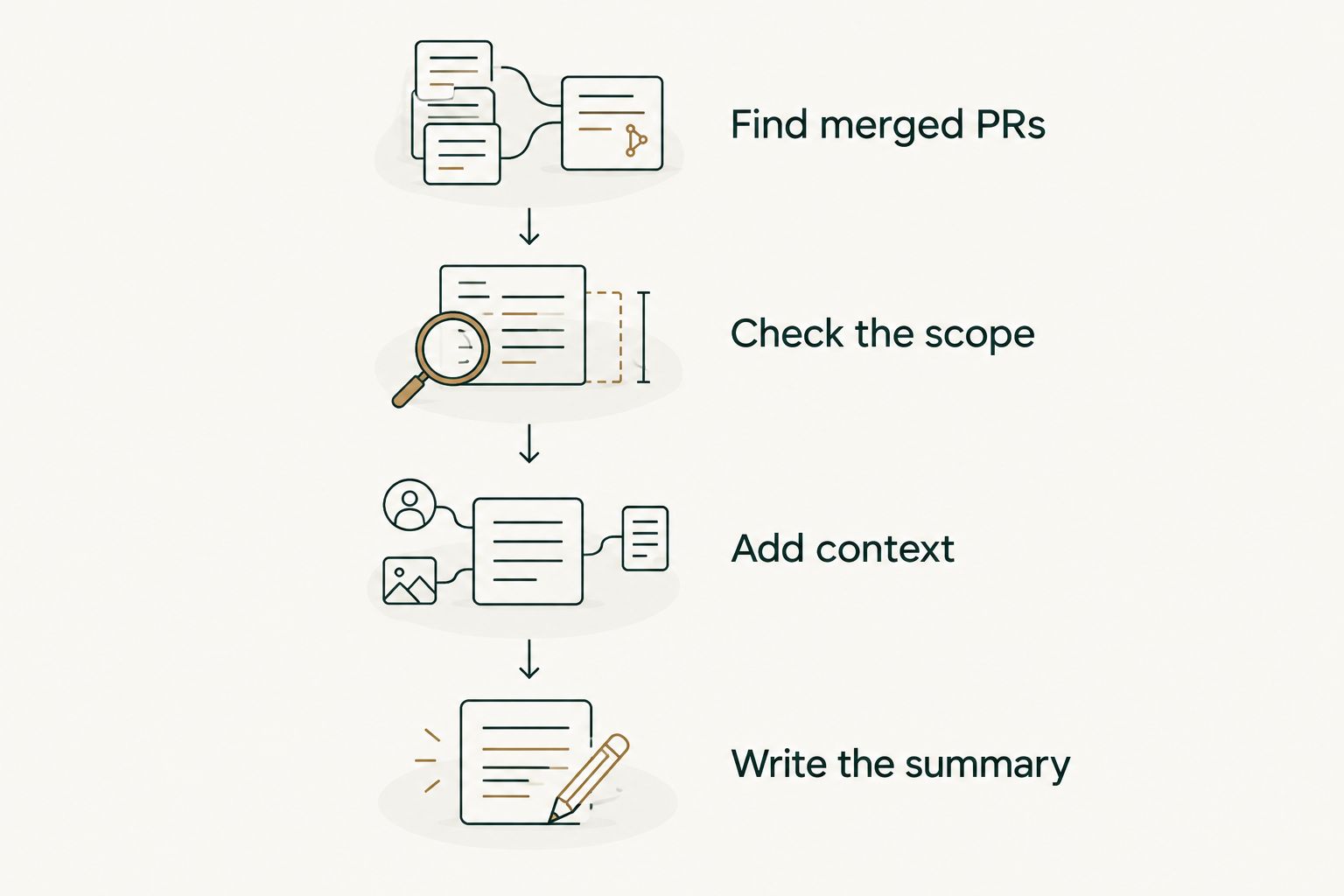
The scope check also prevents accidental omissions. If you changed teams or worked across repositories, verify that the selected grouping matches the work you intend to describe. Do not assume a convenient filter is a complete account of your contribution.
- Find merged PRs.
- Check the scope.
- Add context.
- Write the summary.
Add contribution and outcome context
Read the pull request before writing the achievement. A title can tell you that a change involved authentication or a deployment pipeline, but it does not establish your responsibility, the difficulty of the work, or the result. Use the description and relevant discussion to recover that context.
Describe your contribution precisely. Distinguish implementation from design, review, coordination, and investigation. A merged PR you authored is evidence of a code contribution; it does not automatically represent every decision or every person involved in delivering the change.
Attach an outcome only when you have evidence for it. If you cannot verify a reduction in errors or support requests, describe the delivered change instead. An accurate account of replacing a manual configuration step is stronger than an unsupported claim that you transformed team efficiency.
- Record the problem the change addressed.
- Describe your specific contribution.
- Identify collaborators where relevant.
- Link the outcome to a verifiable source in your working notes.
- Leave unverified numerical improvements out of the summary.
Separate personal evidence from organization-wide decisions
Treat your personal merged-PR record as one source of evidence. It does not include every review, design discussion, incident response, mentoring session, or investigation. A developer’s contribution extends beyond authored code changes, so a self-review needs room for work that does not appear in the search results.
The same boundary matters when a manager reads the report. Comparing developers by merged-PR totals ignores differences in task scope and how teams divide changes. Splitting one feature into several pull requests changes the count without establishing a larger contribution.
For organization-wide analysis, define the process question independently. If the question concerns waiting for review, a merged-only personal record is insufficient because it excludes open work and does not establish a complete history of review events. Select evidence that fits the question rather than stretching the available tally.
- Keep authored PRs separate from reviewed PRs.
- Add non-PR contributions to your review notes.
- Avoid developer rankings based on merge counts.
- Explain differences in repository and task scope.
- Use process-specific evidence for process decisions.
Turn the evidence into a review or job-search narrative
Group the selected work around the problems you solved, not merely the order in which pull requests merged. A monthly list helps you retrieve evidence; a performance-review narrative explains responsibility and results. The finished document should make that distinction visible.
For a 2026 job search, write examples that remain understandable without access to private repositories. Explain the problem, your role, and the change at an appropriate level of detail. Do not copy internal PR descriptions into an external document without permission, and remove confidential customer, system, or security details.
For an internal review, preserve references where the reader has authorized access. Use them as supporting evidence rather than making the reader reconstruct your contribution from a long list. Close each example with an established outcome or a precise statement of what was delivered.
- Group contributions by problem or project.
- Explain your role before describing the implementation.
- Keep internal evidence in an approved location.
- Remove confidential details from external examples.
- Include work that merged outside the main repository.
- Review every outcome claim against its evidence.
Compare your reporting options
Choose the smallest workflow that answers the question. An individual preparing a self-review does not automatically need an organization-wide analytics system. Conversely, a personal merged-history summary cannot establish everything an engineering manager needs to know about review flow.
| Option | Best for | Main strength | Key limitation |
|---|---|---|---|
| GitHub search | Occasional personal merged-PR lookups | Explicit filters let you inspect the selected records | Repeated grouping and narrative preparation remain manual |
| Pulltally | Individual developers preparing recurring delivery summaries | Browses and summarizes merged GitHub PRs by month, organization, or personal repository | Its stated scope is personal merged history, not enterprise-wide process measurement |
| A manually maintained review document | Combining PR evidence with design, support, and mentoring work | Holds context that a PR list does not capture | You must maintain references and verify claims yourself |
| An organization-wide reporting workflow | Managers investigating a defined engineering process | Can be designed around the process question and required evidence | Requires separate decisions about scope, access, definitions, and ownership |
GitHub search is the best starting point when you need to verify a specific period or contribution. A review document remains useful whichever collection method you choose because retrieved records still need interpretation.
For broader reporting, specify required evidence before evaluating options. Do not buy a larger reporting scope merely to avoid writing a personal review, and do not mistake a convenient personal tally for a complete account of an engineering organization.
Common mistakes enterprise developers make
Treating merged counts as performance evidence
A merged count describes activity within the selected scope. It does not establish difficulty, quality, or business impact. Use the tally to find work worth explaining, not to score yourself or compare colleagues. Keep the evidence and the judgment separate.
Mixing merge dates with work dates
A PR can be opened in one reporting period and merged in another. A merge-date summary answers when the change merged, not when all the work happened. Explain substantial cross-period work separately rather than changing the date definition to fit the narrative.
Assuming organization scope means complete coverage
An organization filter narrows your results; it does not prove that every relevant repository or contribution is included. Check team changes, personal repositories, and access boundaries. Record exclusions when they affect how a reader should interpret the summary.
Sending private evidence into an external job search
An internal PR is not automatically appropriate interview material. Keep external examples at a level your organization permits, remove sensitive details, and avoid sharing private links as supporting evidence. A clear explanation of your role does not require exposing internal implementation details.
Presenting delivered changes as verified outcomes
Merging a change establishes that it merged. It does not prove that incidents declined, customers adopted a feature, or a workflow became faster. State the delivered change when outcome evidence is unavailable; add the result only when you can substantiate it.
FAQ
What is PR analytics for enterprise engineering organizations?
PR analytics for enterprise engineering organizations is the analysis of pull request activity to answer defined delivery or workflow questions. Personal merged-history reporting supports contribution summaries; organization-wide process analysis requires evidence suited to the process being investigated.
What is the best way to find my merged GitHub pull requests?
Start with GitHub search using is:pr is:merged author:@me and a merge-date filter. Narrow the results by organization or repository, then check that the selected scope matches your reporting period.
Is Pulltally an enterprise productivity scoring tool?
No. Pulltally provides personal delivery history, not a productivity score. It is a web tool for individual developers to browse and summarize merged GitHub pull requests by month, organization, or personal repository.
What data does the tool access, and why?
The tool uses read-only access to pull request metadata to support browsing and summarizing merged PR history. That metadata access serves the history workflow; it is not permission to modify repositories.
Does signing in connect my private organization repositories?
No. Signing in alone does not connect private organization repositories. Treat sign-in and private organization repository access as separate permission questions, and follow your organization’s approved access process.
Can I use merged PR counts in my performance review?
Yes, as a description of your selected delivery history, not as a performance score. Pair relevant pull requests with your role, the problem addressed, and outcomes you can verify.
Can I use private GitHub work in a job interview?
Describe private work only within your organization’s confidentiality rules. Explain your contribution without exposing private links, customer information, sensitive code, or internal security details.
Can merged PR history show where reviews are getting stuck?
Merged-only personal history is insufficient to establish a complete picture of review delays. Review-flow analysis also needs evidence about the relevant review events and work that remains open.
One last thing
Write the contribution note while the context is still available. A PR title is a useful retrieval cue, but it is not a durable explanation of why the work mattered.
For your next 2026 review, add a short note to your working document after a meaningful change merges: the problem, your contribution, and the evidence for the result. This preserves the explanation that a later tally cannot supply. Keep the note specific enough to support a review and restrained enough to avoid claiming an outcome you have not checked.