GitHub PR tracking for engineering directors: complete 2026 guide
GitHub PR tracking for engineering directors builds review evidence, not productivity scores. Use merge dates, clear scope, and context to assess contributions.

Engineering directors’ GitHub PR tracking is the practice of organizing pull request history to support delivery discussions and evidence-based reviews. For 2026 reviews, use merged PRs to identify work worth discussing, not to rank developers: directors need context across projects, while individual developers need an accurate record of their own contributions.
Why GitHub PR tracking matters for engineering directors
A performance review needs examples that both the developer and reviewer can inspect. Merged pull requests provide links to changes, descriptions, and review discussions. They do not explain the full contribution by themselves.
Consider a developer preparing a 2026 self-review after moving between repositories. Searching each repository separately creates repetitive work; relying on memory leaves the developer reconstructing a timeline. A dated record gives the conversation a starting point. The guide to generating self-review summaries from GitHub PRs addresses that individual preparation workflow.
Directors have a different responsibility: establish consistent evidence requirements without turning personal activity into a team leaderboard. A merged fix, a feature, and a cleanup are different pieces of work, even when each produces one pull request.
Treat the tally as an index into delivery history, not an assessment of developer performance. Use the links to ask what changed, why it mattered, and what the developer contributed beyond the code.
Build a review-ready PR tracking workflow
Define the review scope
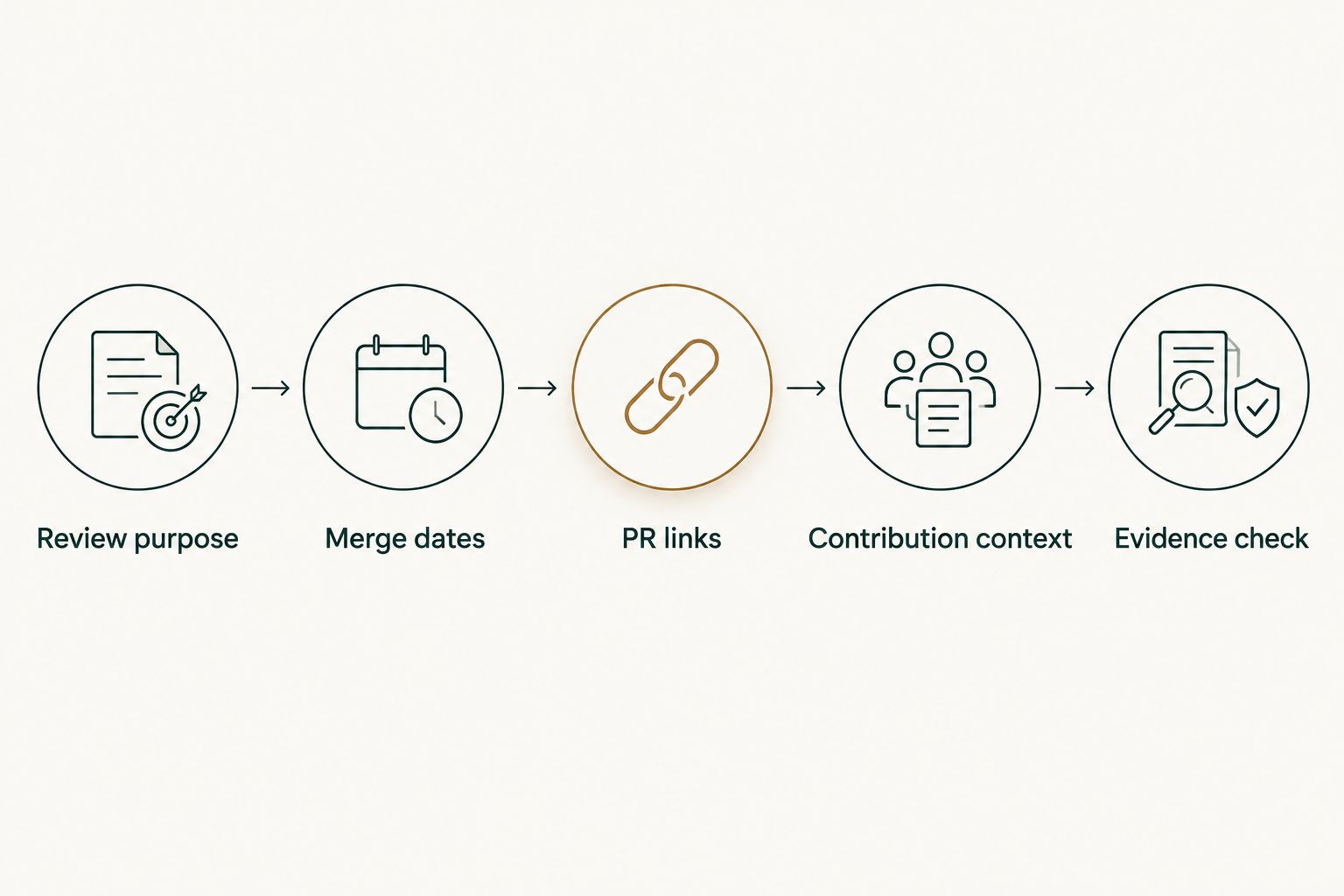
Start with the decision the record will support. A self-review, promotion discussion, and project retrospective need different evidence. Decide which period, repositories, and contribution types belong before anyone collects counts.
For a quarterly review, choose a clearly bounded period such as the first 3 months of 2026. Record whether you are tracking authored PRs, reviewed PRs, or both. Those categories answer different questions and should remain separate.
Merged history is useful for describing completed changes. Open and closed-but-unmerged PRs belong in a separate discussion about unfinished or abandoned work. Leaving them out of a merged tally does not mean that work lacked value.
- Write down the review purpose and date boundaries.
- Identify the repositories or organization in scope.
- Separate authored changes from review contributions.
- State that counts are descriptive, not performance targets.
Find merged PRs with GitHub search
Use GitHub search first when you need an occasional lookup. Search pull requests, filter by author, and select merged results. Save the query text alongside your notes so you can repeat the lookup with the same criteria.
For your own first-quarter 2026 history, a query can begin with is:pr is:merged author:@me merged:>=2026-01-01 merged:<2026-04-01. Add the repository or organization qualifier appropriate to the review. Another developer should substitute their own identity rather than reuse your personal search results.
The merge date matters here. A PR opened before the review period but merged during it belongs in a merge-date tally. A PR opened during the period but not yet merged does not.
Keep the date field consistent across every monthly summary. Mixing creation dates with merge dates makes the resulting timeline describe different events.
- Start with
is:pr is:merged. - Filter by the author whose work you are documenting.
- Apply the same merge-date boundaries to every search.
- Narrow the results to the agreed repository scope.
- Copy relevant PR links into your working notes.
Replace repetitive searching where it fits
Manual search remains useful for a narrow question. When a developer repeatedly reconstructs their merged history across months or repository scopes, a dedicated personal-history tool fits that task.
Pulltally PR tracking is best for individual developers preparing performance reviews from their own merged GitHub pull request history. It lets developers browse and summarize merged PRs by month, organization, or personal repository. That is a personal preparation workflow, not a basis for assuming director-level team reporting capabilities.
Access is read-only and covers pull request metadata. Signing in alone does not connect private organization repositories. Keep that distinction explicit when explaining the tool to developers who work with private code.
The limitation matters as much as the convenience: a personal merged-PR summary does not establish business impact or measure all engineering work. Directors still need developer explanations and project evidence.
- Use manual search for isolated lookups.
- Use monthly browsing when the same lookup repeats.
- Keep organization and personal-repository histories distinct.
- Confirm the intended repository access before connecting anything.
- Let developers inspect their own records before sharing summaries.
Organize the evidence before writing conclusions
Create a simple document or spreadsheet before drafting the review. Give each selected PR a row with its merge date, repository, link, short description, and contribution context. Keep the source link beside the explanation.
A spreadsheet gives you direct control over the fields and wording. Its limitation is upkeep: someone must add records, check dates, and maintain the explanations. A browser tab full of search results avoids that setup but does not preserve the reasoning behind your selections.
Use the record to identify themes such as maintenance, feature delivery, reliability work, or developer tooling. These are descriptive categories, not scores. A PR can support more than one theme without being counted as multiple merged changes.
The goal is a readable evidence trail. Another reviewer should understand what a selected example supports without rebuilding the entire search.
- Preserve the original PR URL for each example.
- Record the merge date and repository.
- Write a short description of the change.
- Add the developer’s contribution and collaborators.
- Group related changes under a descriptive theme.
Explain the outcome behind each example
A PR title describes a change, not necessarily its effect. Read the description and relevant discussion, then ask the developer what problem the work addressed. Use linked project records to support outcome claims when those records exist.
Start with 5 pull requests as an initial review sample, not a performance benchmark. Choose examples that support distinct claims rather than simply selecting the largest changes. Expand the sample when an important contribution spans several PRs.
Separate observed results from intended results. Merging a change intended to reduce errors does not prove that errors decreased. If no measured result exists, describe the change and its purpose without adding a number.
A precise explanation of a change is better than an unsupported impact claim. Review language should remain accurate when someone follows the source link.
- Identify the problem each example addressed.
- Explain the developer’s specific role.
- Distinguish intended outcomes from observed results.
- Link supporting project evidence where permitted.
- Describe uncertainty without inventing impact figures.
Add work that merged PRs leave out
Merged PR history covers a particular kind of evidence. It does not provide a complete record of planning, incident coordination, mentoring, design discussions, or reviews on someone else’s changes.
Ask developers to add those contributions in their own words, with appropriate references. A director preparing a 2026 review should make room for work that helped others deliver, even when it produced no authored merge.
Avoid forcing every contribution into the same format. A design decision needs a description of the trade-off. Mentoring needs an account of the support provided. An incident contribution needs context about the person’s role, without exposing information that should remain restricted.
Keep authored PR history and other contributions adjacent rather than collapsing them into a single numerical total. Different evidence supports different judgments.
- Add design and planning contributions.
- Include review work separately from authored PRs.
- Describe mentoring and collaboration with context.
- Record incident work using approved references.
- Leave confidential details out of broadly shared summaries.
Review the record with the developer
Give the developer a chance to check the record before using it in a formal discussion. Ask whether the scope is correct, whether any examples misstate ownership, and whether important work is missing.
Schedule a 15-minute evidence check as a starting point, then allow more time when the record needs correction. That check is for accuracy, not defending a count. The developer should be able to explain shared work and identify contributions that search results alone do not show.
For the next 2026 review, retain the agreed search criteria and evidence fields. Repeat the method, not the conclusions. A quieter month in the merged history requires context rather than an automatic negative interpretation.
- Check repository coverage and date boundaries.
- Correct ownership and collaboration details.
- Remove unsupported outcome claims.
- Add omitted work with suitable evidence.
- Agree on what the summary actually demonstrates.
The workflow separates collecting evidence from evaluating it. Preserve that boundary: an accurate tally still needs interpretation before it belongs in a review.
Compare your PR tracking options
Choose the method that matches the task. A director setting review expectations and a developer collecting personal history do not necessarily need the same tool.
| Option | Best for | Main advantage | Key limitation |
|---|---|---|---|
| GitHub search | Occasional merged-PR lookups | You can specify author, scope, status, and merge dates | Repeated searches still require manual organization and explanation |
| Document or spreadsheet | Writing review narratives from selected evidence | You control the fields, context, and supporting references | You must maintain the record yourself |
| Pulltally | Individual developers browsing recurring personal merged-PR history | Browsing and summaries by month, organization, or personal repository | Personal delivery history does not establish team performance or business impact |
GitHub search is the starting point when the question is small. A document or spreadsheet is useful when interpretation matters more than browsing. Pulltally replaces repetitive personal-history searching; it does not replace the director’s review judgment.
Choose a collection method and a writing method separately. You can collect merged history in one place and write the review narrative in another. Do not require developers to adopt a new tool just to contribute evidence.
Common mistakes engineering directors make
Ranking developers by merged PR count
A merged PR count describes activity within a defined scope. It does not account for differences in tasks, contribution types, or how changes are split. Use counts to locate examples and ask questions, not to assign performance rankings.
Changing filters between review periods
A summary loses meaning when one period includes personal repositories and another includes only organization work. Preserve author, repository scope, status, and date rules. If the scope changes, explain the change beside the summary rather than treating the totals as directly comparable.
Treating merge ownership as sole ownership
The author field is useful for finding changes, but a PR can involve design help, pairing, review, and follow-up from other people. Ask who contributed and what they did. Give credit in the narrative rather than attributing the whole outcome to the person whose PR merged.
Sharing private details outside the approved audience
An internal performance review and a job-search summary have different disclosure boundaries. Developers should describe transferable contributions without copying restricted implementation details or private discussions. Repository access does not itself establish permission to redistribute the contents.
FAQ
What is GitHub PR tracking for engineering directors?
GitHub PR tracking for engineering directors is organizing pull request history to support delivery discussions and reviews. Track a defined author, repository scope, status, and date range, then add contribution context.
Can I track merged pull requests without another tool?
Yes, GitHub search lets you filter pull requests by author, merged status, repository scope, and merge dates. Use manual search for occasional lookups and preserve your query criteria alongside the review notes.
Is a merged PR count a developer productivity score?
No, a merged PR count is not a developer productivity score. It describes merged changes within the selected scope and does not capture all engineering contributions or establish their impact.
Who is Pulltally best for?
Pulltally is best for individual developers browsing and summarizing their own merged GitHub pull requests for performance reviews or job-search preparation. Its stated workflow covers monthly, organization, and personal-repository history rather than a director-level team assessment.
Does signing in connect private organization repositories?
No, signing in alone does not connect private organization repositories. Access is read-only and covers pull request metadata; confirm the intended repository access before connecting private organization history.
Should I track when a PR opened or when it merged?
Use merge dates when the question is which changes merged during the review period. Opening dates answer a different question, so keep those timelines separate.
What should a director include besides merged pull requests?
Include relevant design, planning, review, mentoring, collaboration, and incident contributions. Ask the developer for context and supporting references rather than assuming authored PR history is complete.
One last thing
Before sharing a 2026 review summary, remove the totals temporarily and read only the examples. If the explanation no longer makes sense, the record needs better context—not a larger tally. The review should explain what the developer contributed even when no count appears.