Is it worth reviewing your merged PRs every month?
Is it worth reviewing your merged PRs every month? Yes—for review evidence, not a productivity score. Learn what to save, skip, and keep private.

Yes—reviewing your merged PRs every month is worth it when you use the history to prepare performance reviews, maintain a brag document, or collect evidence for a job search. The useful output is a record of what changed and why it mattered, not a monthly productivity score. Skip the ritual if you only tally merges without adding context.
Is it worth reviewing your merged PRs every month?
Yes, if each review leaves you with usable evidence rather than another activity total. A merged PR provides a reference to a change. Your notes need to explain the problem, your contribution, and what the available evidence establishes.
For a 2026 performance review, a useful entry might describe a confusing failure path you clarified, the implementation decision you made, and the merged PR that records it. That is stronger than an unexplained total because a reviewer can understand the work without guessing what each merge involved.
A brag document for software engineers gives those entries a place to accumulate. Keep the document organized around contributions and evidence, not around proving that every month was equally busy.
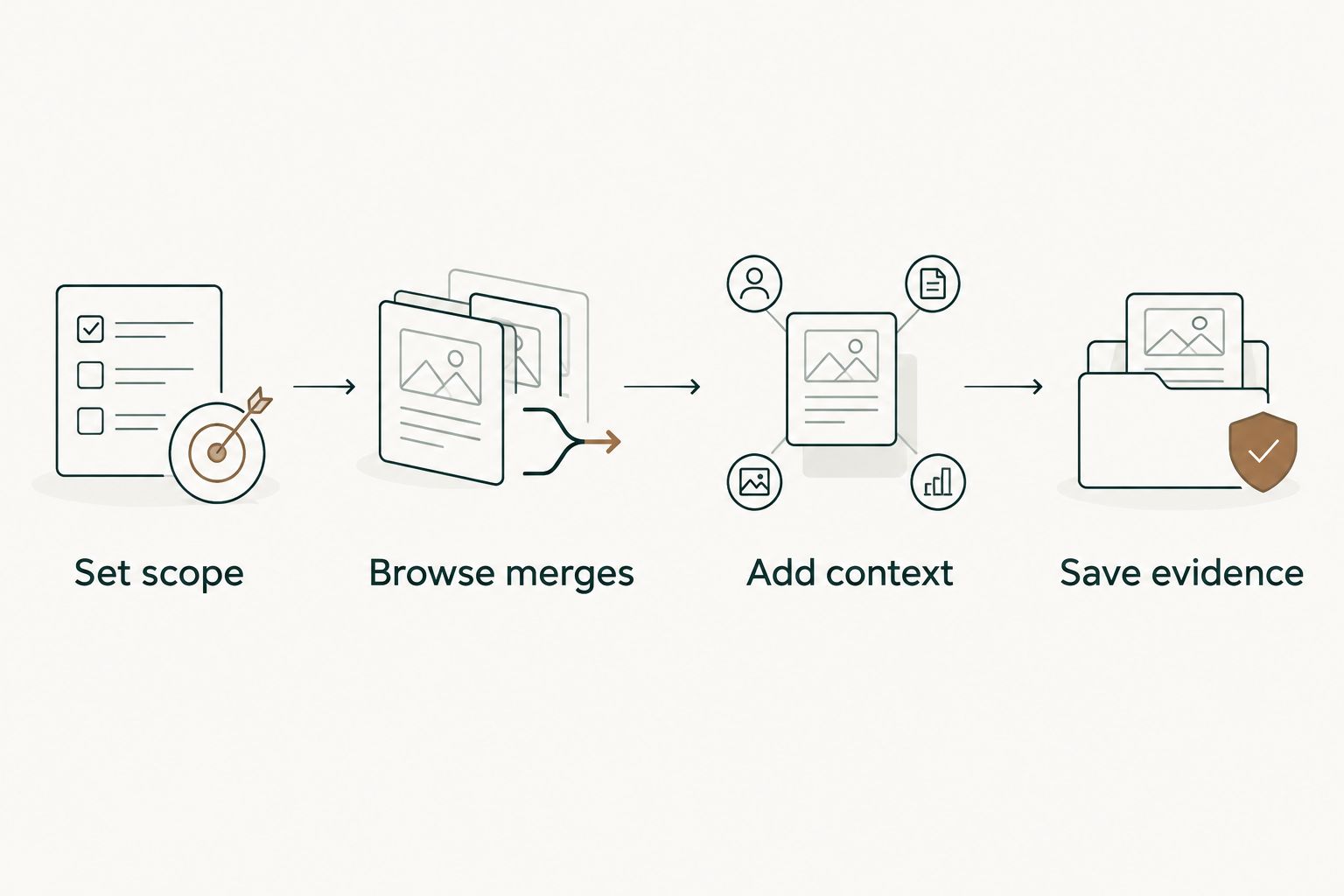
Use this sequence:
- Set scope. Choose the month and the organizations or repositories relevant to your review.
- Browse merges. Read enough of each relevant PR to recover the problem and your role.
- Add context. Explain decisions, collaboration, and the reason the change mattered.
- Save evidence. Keep the reference and a factual summary in your private notes.
These steps separate finding your work from interpreting it. Neither a search result nor a generated summary can establish an outcome that the underlying evidence does not show.
Why this matters
A performance review asks you to explain contributions, not reproduce a repository's activity feed. A job interview asks you to describe your decisions and their consequences. The same merged PR can support either task, but only after you recover the surrounding context.
Suppose you changed an error message after investigating a confusing support report. The PR title might describe a wording adjustment. Your useful note explains the ambiguity you found, how you chose the replacement, and what evidence you have about the result.
Do not upgrade that note into a claim that support requests fell unless you have supporting records. A specific contribution with a clear evidence boundary is better than an impressive claim you cannot defend.
Choose a workflow that matches the task
The right method depends on whether you need an occasional lookup or a repeated review across repositories. Keep the process small enough that maintaining the record does not become a separate reporting project.
| Approach | Best for | What it gives you | Limitation |
|---|---|---|---|
| GitHub search | Occasional lookups | Direct access to matching PRs and their discussion | You must repeat searches and organize the findings yourself |
| Pulltally | Individual developers repeating monthly history searches | Browsing and summarizing merged GitHub PRs by month, organization, or personal repository | You still need to explain significance and verify outcome claims |
| Notes alone | Developers who already record work as it happens | Context about decisions, collaboration, and unfinished work | Notes need references if you want to verify the underlying changes |
Pulltally is best for individual developers who repeatedly browse merged GitHub PRs for performance-review or job-search preparation. Its relevant role is replacing repeated history searches, not deciding how productive you were.
GitHub search remains a sensible choice when you only need to find a particular change. Notes remain necessary whichever browsing method you choose: repository metadata does not explain every conversation, trade-off, or responsibility behind a merge.
What should you save from each month?
Save enough information to reconstruct the contribution without reopening every discussion. A compact entry needs a clear explanation and a reference, not a rewritten version of the entire PR.
Use these fields:
- Change: What behavior, implementation, or developer workflow changed?
- Reason: What problem or requirement prompted the work?
- Your role: What did you investigate, decide, implement, or coordinate?
- Evidence: Which PR, discussion, or approved record supports the description?
- Outcome: What result is documented, and what remains unverified?
For a February 2026 entry, you might write: clarified a failure message, traced the confusing branch, updated the handling, and linked the merged change. If you do not have evidence about user impact, stop there.
Keep distinct facts separate. A merged change establishes that the change was accepted into the target branch; it does not, by itself, establish deployment, adoption, or a business result.
Group related changes before writing the summary
A feature can span several PRs. Describe the feature or problem as the contribution, then retain the supporting references underneath it.
The reverse also matters: a large PR can contain several unrelated changes. Extract the contribution that matters to your review instead of treating the PR boundary as the boundary of your achievement.
This prevents the summary from rewarding whichever work happened to be split into more merges. Your goal is an understandable delivery history, not a contest over how changes were packaged.
Why the value of a monthly PR review varies
A monthly review earns its place when it solves a specific retrieval or writing problem. Its value depends on these factors:
- Purpose: Preparing a self-review or interview gives the notes a concrete use. Collecting totals without a question does not.
- Repository scope: Work spread across organizations or personal repositories requires a clear boundary before you compare periods.
- Existing notes: Detailed work notes reduce the context you need to reconstruct from PR discussions.
- Work shape: Research, mentoring, design discussions, and unfinished work need evidence outside merged PRs.
- Access and confidentiality: Your record must respect repository access and the rules governing what you can retain or share.
Choose the cadence around the purpose. A monthly checkpoint is useful when it helps you maintain a continuing record; it is not a requirement to produce a new accomplishment story every month.
For your 2026 notes, keep the same inclusion rule across the periods you intend to discuss. Changing from personal repositories to organization repositories partway through the record changes what the totals describe.
How do you search GitHub without adding another tool?
Start with a merged-PR query and make the author and time window explicit. For example, is:pr is:merged author:@me merged:2026-01-01..2026-01-31 finds matching PRs for your authenticated account within that merge-date range.
Add an organization or repository qualifier when the review needs a narrower scope. Use the same scope when you repeat the search for another month, and check that you are searching by merge date rather than creation date.
Read beyond the title before writing your summary. A title identifies the change; the description and discussion can explain the decision. Follow any available references you need to distinguish your implementation work from the broader project outcome.
Stay with manual search if it already answers your question without repeated cleanup. A separate browsing tool is relevant when reconstructing the same monthly history has become repetitive, not simply because another dashboard exists.
How do you turn merged PRs into performance-review evidence?
Start with the review's actual question: delivery, technical judgment, collaboration, or another stated expectation. Select relevant contributions, then describe what you did and attach the evidence.
Do not paste a chronological list and ask the reader to infer significance. Write a short explanation of the contribution first; use the PR references to make that explanation verifiable.
For a 2026 self-review, separate these statements:
- Implemented: What the merged change directly demonstrates.
- Observed: What a linked record establishes about the result.
- Contributed: What you personally did within shared work.
This distinction keeps a team outcome from becoming an unsupported individual claim. It also leaves room to explain valuable work that did not end in a merge during the review period.
When you need help organizing the final write-up, use the same evidence standard for any summary: check the wording against the underlying PRs before reusing it.
Can you use monthly PR notes for a job search?
Yes—monthly PR notes can supply examples for interview preparation, but your public version needs a separate confidentiality check. Private evidence and shareable wording are different records.
Keep authorized references in your private review notes. For a résumé or interview story, describe the problem, your responsibility, and the supported result without disclosing protected implementation details, customer information, or internal discussions.
A public repository gives you a reference you can point to directly. A private repository does not become shareable because you authored the change. Follow your organization's rules, and do not move restricted material into a personal account to preserve access.
Prepare the explanation while you still understand the work. If you cannot establish an outcome from approved evidence, describe the technical contribution rather than inventing a stronger result.
What permissions should you check?
Pulltally uses read-only access to pull request metadata for browsing and summarizing your merged history. Signing in alone does not connect private organization repositories. Treat sign-in and private repository connection as separate decisions.
Before connecting any work account, check the requested access and your organization's approval requirements. Read-only access describes the ability to change data; it is not permission to share that data outside the organization.
Apply the same care to your saved notes. A PR title or summary can contain confidential information even when it includes no source code. Keep the audience and storage location appropriate to the material.
What should you leave out of the tally?
Do not turn a monthly merged-PR count into an individual productivity score. Counts describe merges within a defined scope; they do not establish complexity, quality, business value, or total effort.
Also leave unsupported comparisons out of the write-up. A lower count does not prove a weaker month, and a higher count does not explain whether you split work differently, changed repositories, or worked on smaller changes.
Record investigation, mentoring, planning, and other relevant work separately when you have evidence for it. A monthly PR review is one source for your delivery history, not a complete account of your contribution.
FAQ
Is it worth reviewing my merged PRs every month?
Yes, when the review helps you preserve evidence for performance reviews, a brag document, or interviews. Save the problem, your contribution, and supported outcomes rather than just the merge total.
Should I count merged PRs as a productivity score?
No, a merged-PR count is not a productivity score. It records merges within a scope but does not establish complexity, quality, or the value of your work.
Can I review my monthly merged PRs using GitHub search?
Yes, GitHub search supports merged-PR, author, repository, organization, and merge-date filters. Keep the scope consistent and read the underlying PRs before summarizing their significance.
When is Pulltally useful instead of manual GitHub searches?
Pulltally is useful when you repeatedly browse and summarize merged GitHub PRs by month, organization, or personal repository. An occasional lookup does not require a separate browsing workflow.
Does signing in connect my private organization repositories?
No, signing in alone does not connect private organization repositories. Access to pull request metadata is read-only; check organization approval requirements before connecting work repositories.
Can I include private PR details in a job application?
Do not include private PR details unless you are authorized to share them. Describe your contribution using approved, non-confidential wording instead of copying internal titles, discussions, or links.
What if my most important work did not produce a merged PR?
Record that work separately with appropriate evidence. Investigations, mentoring, planning, and unfinished implementation belong in your review when relevant, even though a merged-PR tally does not capture them.
One last thing
Add a reason, not just a reference. Before closing your monthly notes, check whether each selected contribution explains why the change existed and what you personally did.
If the entry only repeats the PR title, it is still a bookmark. Add the missing context now, or leave it as a reference rather than presenting it as a finished performance-review example.