GitHub merged PRs to interview talking points: 2026 workflow
Turn GitHub PRs to interview talking points with merged-PR searches, evidence checks, and story outlines. Prepare clear answers without inventing impact.

Instead of manually searching GitHub before every interview, build a repeatable workflow that turns merged pull requests into evidence-backed stories about your decisions, contribution, and results. Use GitHub search for an occasional lookup or Pull Tally for repeated browsing by month, organization, or personal repository, then write talking points from the underlying work.
Why this matters
A merged pull request tells you that a change entered a repository. It does not, by itself, tell an interviewer why the change mattered, which decisions you owned, or what happened after deployment.
For a 2026 job search, treat your PR history as an index to evidence, not a finished account of your accomplishments. Find the change first. Then recover the problem, alternatives, collaboration, and outcome from the PR discussion and other records you are authorized to use.
Personal delivery history, not a productivity score. A count helps you locate work across time; it does not establish the difficulty or value of that work.
This workflow ends with a small set of interview stories that you can defend under follow-up questions. It also preserves the boundary between your contribution and the team's result.
Before you start
- Account and repository access: Use your GitHub account and repositories you are authorized to view. Pull Tally uses read-only access to pull request metadata; signing in alone does not connect private organization repositories.
- Working materials: Open a private notes document and choose the interview role you are preparing for. Keep supporting PR references and notes about your contribution together.
- The setup gotcha: An author-filtered search misses PRs you reviewed but did not author, and a merge date is not a deployment date. Decide whether you are collecting authored delivery work, collaboration examples, or both before searching.
Set aside an initial 30-minute review session. That is a suggested time box, not a promise that every repository or career history fits into it. Stop once you have enough material to investigate rather than trying to catalogue everything.
Choose your history source
Use the smallest workflow that removes your actual repetition. You do not need a separate tool to inspect a single known pull request.
| Option | Best for | What it does | Advantage | Limitation |
|---|---|---|---|---|
| GitHub search | An occasional lookup or a known repository | Finds pull requests using search qualifiers | Lets you inspect the original PR and discussion | You must repeat and adjust searches when reviewing different periods or scopes |
| Pull Tally | Individual developers repeatedly reviewing merged history | Browses and summarizes merged PRs by month, organization, or personal repository | Replaces repetitive searching across those views | Pull request metadata alone does not establish business impact or explain every decision |
Neither option writes a trustworthy interview story without your judgment. The history source finds candidates; you supply the context and verify the claims.
Keep GitHub search for one-off questions. Use a monthly history view when rebuilding the same searches becomes the work.
Search scope
Start with one period and one repository or organization. A bounded search gives you a manageable set of changes to inspect before expanding your scope.
- Set the period. Choose a period relevant to your interview examples. For a completed January 2026 window, use
merged:2026-01-01..2026-01-31. Change the dates to match your actual work history. - Find authored work. In GitHub's search field, enter
is:pr is:merged author:@me merged:2026-01-01..2026-01-31. Submit the search to list merged pull requests authored by your signed-in account within that interval. - Narrow the scope. Add
repo:OWNER/REPOSITORYfor a specific repository ororg:ORGANIZATIONfor an organization. Replace those uppercase tokens with the actual repository owner, repository name, or organization name; they are search syntax examples, not literal values to retain. - Check the results. Open a result and verify its author, repository, merged status, and merge date. Confirm that your search found the intended work before using the result count in your notes.
- Use a history view if needed. If you are using the monthly browsing workflow, choose the relevant month and organization or personal-repository scope. Still open the underlying PR when you need evidence beyond its metadata.
Expected result: You have a bounded list of merged PRs associated with the period and scope you intended. You have not yet classified those changes as accomplishments.
For your 2026 preparation notes, record the search interval beside the list. This prevents a later refresh from silently mixing a different period into the same story collection.
Evidence notes
Read for decisions rather than impressive-looking titles. A small change with a clear trade-off can support a stronger interview answer than a large change whose purpose you cannot explain.
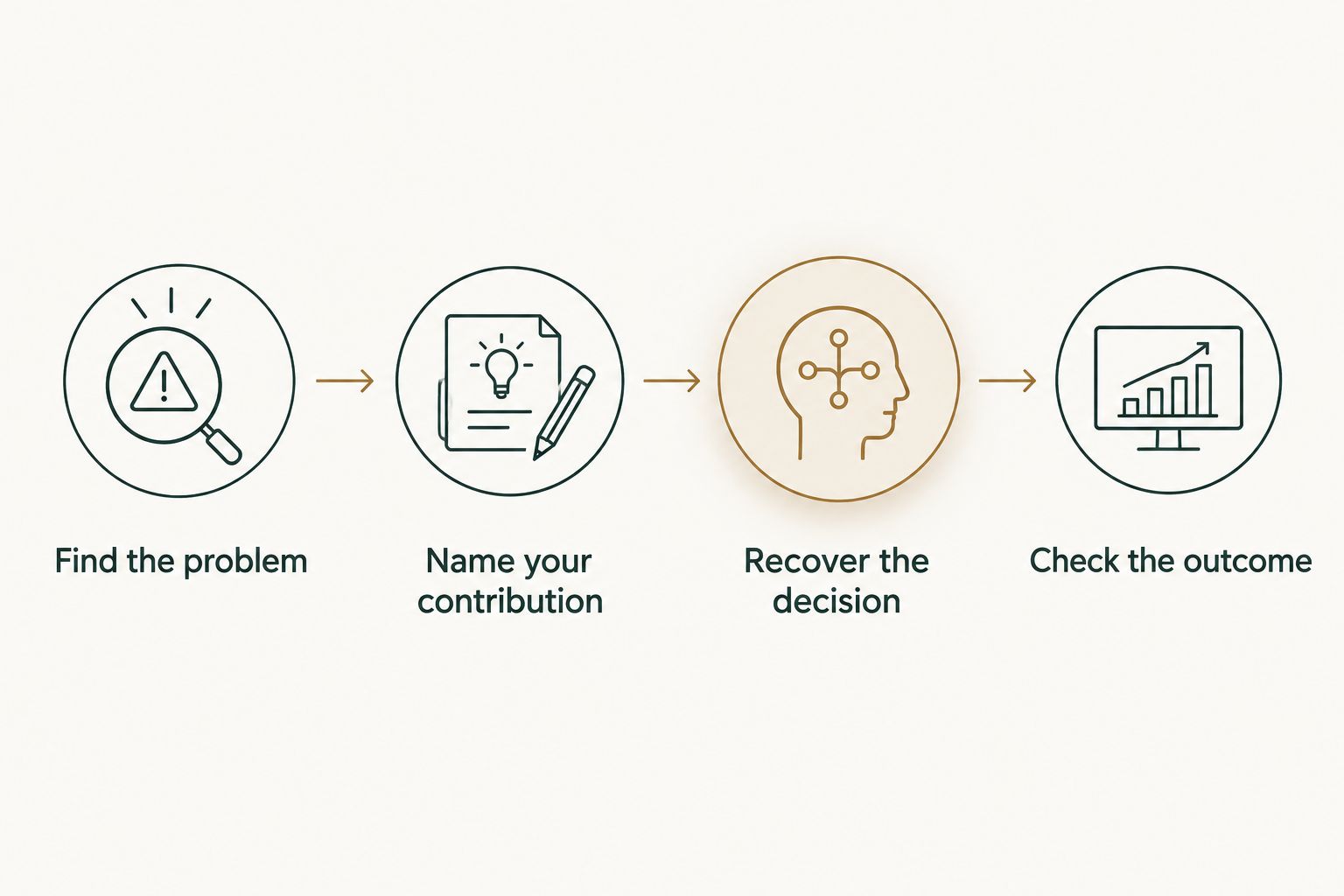
- Find the problem. Read the PR description and any linked issue you can access. Write down what was broken, missing, slow, confusing, or difficult before the change. If the record does not explain the problem, mark it for investigation rather than filling the gap.
- Name your contribution. Describe the part you implemented, investigated, proposed, or coordinated. Separate your work from changes made by other contributors, and distinguish writing code from reviewing it.
- Recover the decision. Inspect review comments and revisions. Identify the choice you made, the alternative considered, and the constraint that affected the choice. Do not describe ordinary implementation as an architectural decision unless the evidence supports that description.
- Check the outcome. Find the strongest supported result: a merged fix, a verified behavior change, an accepted design, or a documented operational outcome. A merge supports a delivery claim; it does not prove adoption, revenue, or incident reduction.
- Mark the boundary. Add a note explaining what you cannot establish. This keeps an uncertain deployment date or undocumented downstream effect out of your spoken answer.
Expected result: Each candidate has a problem, a personal contribution, a decision, and a supported outcome—or a clearly identified gap that prevents using it yet.
Use this compact worksheet for each candidate:
| Note | What to write | What to avoid |
|---|---|---|
| Problem | The behavior or constraint you needed to change | A generic claim that the system needed improvement |
| Contribution | Your specific actions and responsibility | Taking ownership of the entire team's work |
| Decision | The chosen approach and a real alternative | Inventing a rejected approach after the fact |
| Evidence | The PR discussion, issue, test, or authorized result record | A remembered number without a source |
| Outcome | What the records establish | Treating merged as deployed or successful |
Keep confidential details in authorized systems. For interview notes, describe the engineering problem without copying private code, customer identifiers, internal incidents, or sensitive business information.
Interview story notes
Choose 3 candidate stories for the first pass: one technical decision, one collaboration example, and one problem-solving example. These are suggested preparation categories, not a requirement to force every PR into a different box.
- Match the question. Label each candidate with the question it answers, such as explaining a trade-off, handling review disagreement, or investigating a difficult defect. Reject candidates that only demonstrate activity.
- Draft the opening. State the problem and your responsibility in plain language. An interviewer should understand the situation without knowing your employer's repository structure or internal project names.
- Explain the action. Describe what you investigated, what you changed, and why. Include the relevant constraint and alternative, but leave out unrelated implementation details.
- State the result. Use only the outcome your evidence supports. If you know the change merged but lack deployment evidence, keep the result at that boundary.
- Prepare follow-ups. Write short notes on testing, risk, collaborators, rejected alternatives, and what you would change next time. These notes matter more than polishing the opening sentence repeatedly.
- Rehearse aloud. Aim for a 60-second opening answer as a practice constraint. Then expand only when the interviewer asks for depth.
Expected result: You have a short answer that makes your contribution clear, plus supporting notes for technical and behavioral follow-ups.
The sequence is simple: Find the problem, Name your contribution, Recover the decision, and Check the outcome. Those evidence notes should remain visible while you draft.
Do not turn the answer into a tour of every commit. Lead with the engineering problem, explain the decision, and stop at the supported result. Your detailed notes are there for questions, not for reading aloud.
Update your notes whenever another PR merges
A second workflow avoids reconstructing everything at interview time: keep a lightweight delivery note as work merges. This is a manual documentation habit, not a claim that your history tool automatically creates interview stories.
After a meaningful merge, record the problem, your contribution, the decision, and the current evidence. If deployment or another outcome occurs later, update the note then rather than assuming it happened at merge time.
At your next monthly review in 2026, browse the merged history and compare it with your notes. Add missing candidates, correct incomplete outcomes, and remove stories whose evidence remains too thin.
This variant is best for developers preparing performance reviews alongside job-search material. The history remains the same; the audience changes which details you emphasize.
Troubleshooting
Private organization PRs are missing
Signing in alone does not connect private organization repositories. Check the repository permissions and connection requirements before concluding that your history is empty. Do not bypass an organization's access policy to collect interview evidence.
A month includes the wrong work
Check whether you filtered by creation date or merge date. Use the merged: qualifier when the question is what merged during a period, and verify the boundary dates on individual results.
A collaboration example is absent
An authored-PR search excludes work you only reviewed. For review examples, run a separate search using is:pr is:merged reviewed-by:@me, with the same period and scope qualifiers. Inspect the discussion to establish what your review actually contributed.
The title sounds important but proves little
Open the description, review discussion, and linked records. If you still cannot explain the problem or your responsibility, leave the PR out of your shortlist. A memorable title is not evidence.
The result depends on an unsupported number
Remove the number and state the supported outcome. If you want to discuss a measured improvement, find an authorized source for the baseline, measurement period, and result before using it.
Customize your workflow
For a technical interview, prioritize decisions, testing, constraints, and alternatives. For a behavioral interview, emphasize responsibility, disagreement, communication, and the actions you took to resolve the problem.
For a performance review, preserve the period and team context so the reader can understand what you delivered. Do not convert the same history into a productivity ranking.
Keep a reusable evidence worksheet, but rewrite the spoken answer for each audience. In 2026, the useful output is still a defensible account of your work—not a larger tally.
FAQ
How do I turn GitHub PRs into interview talking points?
Find relevant merged PRs, verify your contribution and decisions, then write a short story with a supported outcome. Use the original discussion to prepare for follow-up questions rather than relying on the PR title.
Is Pull Tally better than GitHub search for interview preparation?
Pull Tally is best for individual developers replacing repetitive merged-PR searches during interview preparation. GitHub search is sufficient for an occasional lookup or a specific PR; neither replaces checking the underlying evidence.
Does signing in connect my private organization repositories?
Signing in alone does not connect private organization repositories. Access is read-only and concerns pull request metadata; check the organization connection and permissions before expecting private history to appear.
Does a merged pull request prove business impact?
A merged pull request proves that the change merged, not that it produced business impact. Use deployment records or other authorized evidence before claiming adoption, operational improvements, or commercial results.
Can I use PRs I reviewed instead of authored?
Yes, reviewed PRs can support collaboration and technical judgment stories when the discussion establishes your contribution. Search them separately with reviewed-by:@me and avoid claiming authorship of another developer's implementation.
How many pull requests should I include in an interview answer?
Include the PRs needed to explain one coherent story, rather than aiming for a count. Several related changes can support one example, while a single well-documented decision can stand on its own.
Can I discuss private repository work in a job interview?
Discuss private work only within your confidentiality obligations and your employer's policies. Explain the problem, decision, and your contribution without sharing private code, customer information, or restricted records.
One last thing
Reopen the review comments before you finalize a story. They can contain the constraint or rejected alternative that the final diff no longer explains.
If you cannot answer why you chose the approach, keep investigating. An honest account of a modest change is more defensible than an impressive claim you cannot support.