How often should engineers update their brag documents?
How often should engineers update their brag documents? Update weekly, capture milestones, and review monthly to keep evidence ready for performance reviews.

Update your engineering brag document weekly, add a note when meaningful work finishes, and review the accumulated entries monthly. Use the weekly pass to capture evidence and context—not just merged pull requests—then use the monthly pass to turn those notes into accomplishments you can explain in a performance review or job interview.
How often should engineers update their brag documents?
Use a weekly capture habit, a monthly editing pass, and an extra update after a meaningful milestone. Treat this as a practical schedule, not a performance standard. The right cadence keeps useful context without turning documentation into another reporting obligation.
If you are starting a document for your 2026 review, the complete guide to brag documents for software engineers provides the broader structure. For maintenance, separate recording what happened from deciding which accomplishments deserve emphasis.
| Cadence | Best for | What to record | Advantage | Limitation |
|---|---|---|---|---|
| Weekly | Routine maintenance | Finished work, decisions, feedback, and evidence | Keeps recent context close to the event | Needs editing before it becomes a review narrative |
| After a milestone | Work with a clear turning point | Your role, the result, and supporting references | Captures details while they are fresh | Misses steady work without obvious milestones |
| Monthly | Finding themes | Related entries grouped into accomplishments | Connects individual tasks to a broader contribution | Works poorly if you have no source notes |
| Before a review | Selecting evidence | Relevant accomplishments and unresolved questions | Focuses the final narrative | Becomes a reconstruction exercise if used alone |
Do not choose between weekly notes and monthly summaries. They serve different purposes. Weekly notes preserve details; monthly summaries explain what those details add up to.
Why this matters
A brag document should help you answer a specific question: what did you contribute, and what evidence supports that account? A list of tasks answers only part of it.
Consider an engineer who merges a migration change, helps another developer understand the rollout, and records a decision about compatibility. The pull request preserves the code change. Your notes need to preserve the reasoning, collaboration, and outcome that belong in a review or interview answer.
For your 2026 performance review, keep the distinction between activity and impact explicit. A merge is an event you can verify; a claim that the change improved reliability needs separate evidence. Record the event immediately, but wait for evidence before claiming an outcome.
That distinction also prevents the document from becoming a productivity score. Your delivery history is useful evidence, not a ranking of your worth as an engineer.
Weekly updates: capture evidence without writing a self-review
A weekly update is the working layer of your document. Write enough to recover the story later, but do not polish every entry into promotion language.
Use a recurring point in your workweek as the trigger. Before you finish the update, check your recent work against your notes rather than relying entirely on memory. Include unfinished work when a decision, investigation, or collaboration already represents a meaningful contribution.
A useful entry answers these questions:
- Context: What problem or request were you working on?
- Contribution: What did you personally implement, investigate, decide, or explain?
- Evidence: Which permitted reference supports the entry?
- Outcome: What changed, and what remains unverified?
- Collaboration: Who else contributed, and how should their work be credited?
For example, a hypothetical entry could say: Implemented the compatibility change and documented the rollout decision. The pull request is merged; the rollout outcome still needs confirmation. That is more useful than Worked on migration, without pretending the merge proves a business result.
Keep the format easy to repeat. If every entry requires a finished story, you are asking a capture habit to do the job of a final review.
What should you leave out of weekly notes?
Leave out routine detail that does not help explain a contribution. You do not need to copy every commit message or reproduce an entire issue discussion.
Also leave out confidential material that you are not permitted to retain. Use approved references inside your employer's systems, and follow workplace rules about what belongs in a personal document. A brag document is not permission to export internal information.
Milestone updates: preserve the part a weekly pass might miss
Add a short note after a project milestone, incident follow-up, consequential design decision, or useful piece of feedback. The trigger is meaningful context, not simply a calendar date.
For a release, distinguish implementation from deployment and deployment from the observed result. For an incident, distinguish your investigation from the team's response. For mentoring, describe the help you provided without treating another person's success as entirely your achievement.
Record the point where your contribution is easiest to describe accurately. If an outcome is still pending, say so and add a reminder to revisit the entry.
Do not wait for a project to finish before recording work that already has a clear contribution. A long-running project can contain design work, risk reduction, documentation, and coordination worth remembering before its final release.
The limitation of milestone-only updates is straightforward: quiet, continuous work lacks a dramatic trigger. Keep the weekly pass so that maintenance and collaboration do not disappear from the record.
Monthly updates: turn entries into accomplishments
A monthly pass is for grouping and editing, not recreating every workday. Read your recent notes and ask which entries describe parts of the same contribution.
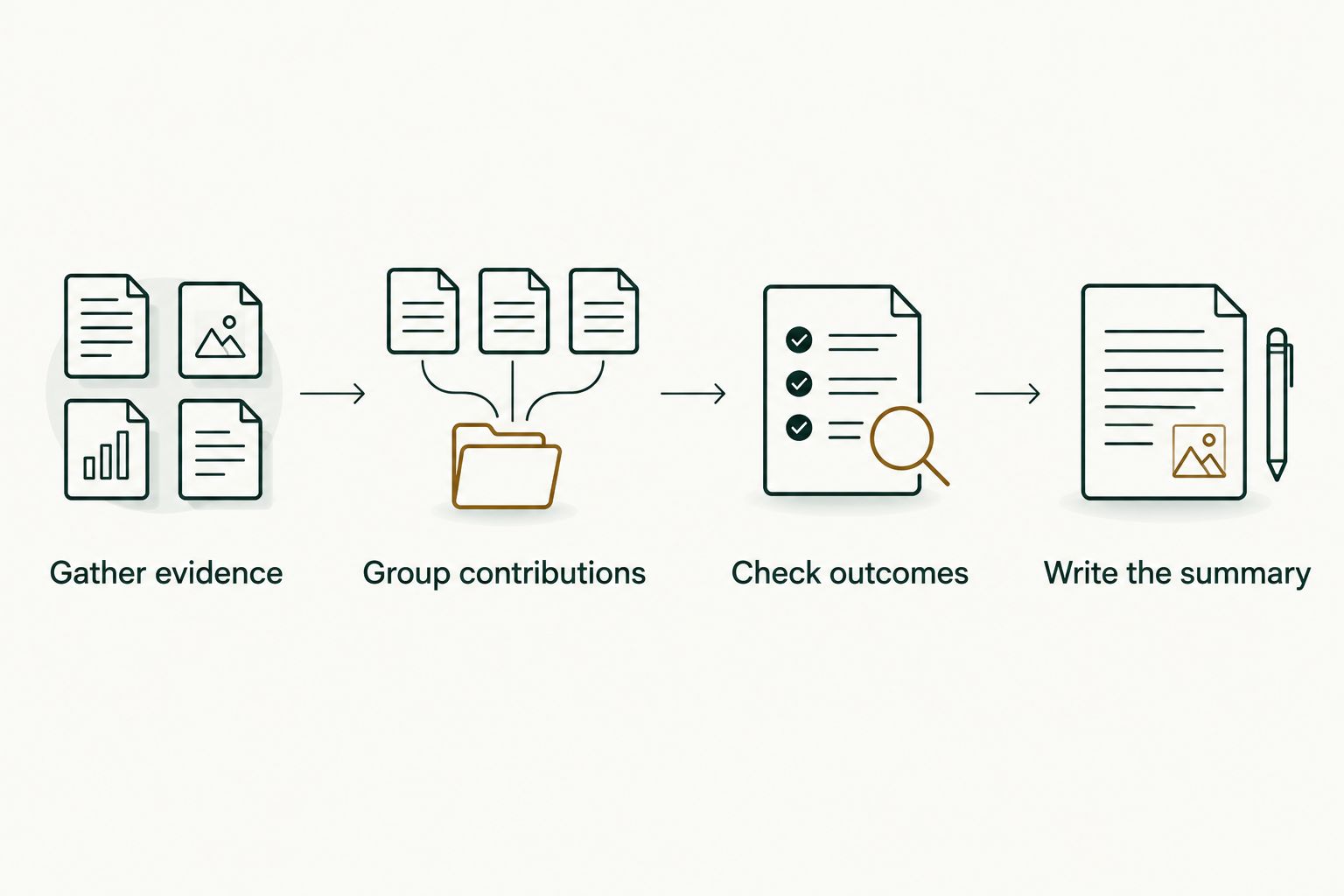
Your monthly process can follow this sequence:
- Gather evidence. Bring together your existing notes and the references you are permitted to use.
- Group contributions. Connect related implementation, review, documentation, and coordination work.
- Check outcomes. Separate observed results from intentions and unresolved questions.
- Write the summary. Explain the problem, your role, and the supported result in plain language.
These steps keep source material separate from the narrative. You can shorten the summary without losing the references that support it.
For a 2026 job search, this monthly pass also gives you material to assess for interview use. Choose examples you can discuss without disclosing confidential details, and preserve the distinction between your contribution and the team's result.
Do not force every month into an impressive headline. An accurate account of maintenance, investigation, or learning is better than an unsupported claim of impact.
Where merged pull request history helps
When the repetitive part is finding your own merged changes, Pulltally lets individual developers browse and summarize merged GitHub pull requests by month, organization, or personal repository. Pulltally is best for individual developers rebuilding merged pull request history for reviews or job searches.
Use that history as an evidence index, not a finished assessment. It does not explain every design conversation, mentoring contribution, or operational decision; your notes still need to supply that context.
Access is read-only and covers pull request metadata. Signing in alone does not connect private organization repositories. Keep permissions separate from the writing task, and check what you are connecting before using private work history.
Why your update frequency varies
Adjust the schedule when the work changes, not because a fuller document looks more impressive. The useful factors are the ones that affect what you need to remember and how you will use it.
- Work rhythm: Frequent small changes suit a weekly collection pass; long projects also need notes about intermediate decisions.
- Evidence location: Work spread across pull requests, issues, and discussions requires checking more than a merged-change list.
- Outcome timing: A merged change can be recorded now while its result remains an open follow-up.
- Review expectations: Your employer's review questions determine which evidence needs explanation, not whether every task deserves an entry.
- Job-search boundaries: Interview preparation requires examples you can discuss without copying restricted information.
- Non-code contributions: Mentoring, planning, and coordination need deliberate notes because merged pull requests do not fully represent them.
The practical test is whether you can explain an entry later without reconstructing its context from scratch. If you repeatedly cannot, capture closer to the event. If your document is mostly repetitive task lists, simplify the entries rather than abandoning the habit.
Should I update my brag document every day?
Daily updates are optional; weekly capture is the recommended default here. Add a same-day note when you finish something whose reasoning, feedback, or ownership details would be difficult to reconstruct later.
Do not make a daily entry a requirement to demonstrate that you worked. Some useful engineering work produces a decision, a clearer problem statement, or help for a teammate rather than a merged change.
For your 2026 routine, keep the habit tied to evidence. A short note with a clear contribution is enough; an empty day does not need filler.
Is updating a brag document monthly enough?
Monthly editing is enough for summarizing, but it should not be your only capture point. Keep weekly notes or milestone entries underneath the monthly summary so you have something concrete to edit.
If you prefer a single document, use dated working notes below a summary section. You can move the strongest examples into the summary without deleting the source context.
Avoid treating the end of the month as a deadline to manufacture an accomplishment. The purpose is to organize evidence, including work whose outcome is not yet known.
When should I prepare my brag document for a performance review?
Prepare the review version when your employer's review process begins, using the notes you have maintained throughout the period. Match the final selection to the actual review prompts rather than assuming your whole work log belongs in the submission.
For a 2026 review, check each selected example for clear ownership, supporting evidence, and an accurately stated result. Replace vague praise with a concrete description of what you did.
Keep the working document separate from the submitted narrative. The working document can contain questions and pending outcomes; the final narrative should make those limits explicit wherever they affect a claim.
FAQ
How often should I update my engineering brag document?
Use weekly capture, milestone notes, and a monthly review as a practical starting schedule. Weekly notes preserve context; monthly editing turns related work into accomplishments.
Do I need to write in my brag document every day?
No, daily entries are not required. Add a same-day note when a decision, feedback conversation, or milestone contains details you want to preserve.
What should I add when I have no merged pull requests?
Record meaningful investigation, design decisions, mentoring, documentation, or coordination. Explain your contribution and supporting evidence without inventing an outcome.
Can I use merged pull requests as my whole self-review?
No, merged pull requests are evidence of delivered changes, not a complete account of your contribution. Add the problem, your role, relevant collaboration, and any verified outcome.
Can Pulltally help me update my brag document?
Pulltally helps you browse and summarize merged GitHub pull requests by month, organization, or personal repository. Use that history to find evidence, then add context and non-code contributions yourself.
Does signing in connect my private organization repositories?
Signing in alone does not connect private organization repositories. Access is read-only and covers pull request metadata; check permissions before connecting private work history.
Should I put confidential work in a personal brag document?
Follow your employer's information-handling rules and do not copy restricted material into a personal document. Use permitted references and prepare interview examples that do not disclose confidential details.
What if I have not updated my brag document for months?
Start with the review period and reconstruct supported examples from permitted work records. Mark uncertain outcomes honestly, then begin weekly capture instead of trying to recreate every workday.
One last thing
Keep an unresolved-outcome note beside work that has merged but has not yet produced an observed result. Revisit that note during the monthly pass instead of silently converting an intention into an accomplishment.
That small distinction makes the document useful twice: first as an accurate record of your work, then as a source of defensible review and interview examples. Your 2026 document does not need to sound impressive at capture time. It needs to be clear enough that you can explain the work later.