How long should a software engineer self-review be?
How long should a software engineer self review be? Follow your employer’s limit, then keep evidence of impact, ownership, and growth—not a task log.

A software engineer self-review should fit your employer’s requested length and include enough evidence to explain your impact, ownership, and growth—not every task you completed. For a 2026 review, keep the main narrative concise and put supporting details in links or an appendix when the review format allows it.
Why this matters
Your reviewer needs to understand what changed because of your work. A long list of tickets, commits, and pull requests leaves that interpretation to someone else.
Write for a decision, not for an archive. Explain the contribution, show the evidence, and stop when additional detail no longer changes the reader’s understanding. Keep the fuller record in a brag document for software engineers, rather than making the self-review carry your entire work history.
Length becomes easier to manage once you separate the review from the notes used to write it. Your notes can be extensive; the submitted review needs selection.
How long should a software engineer self-review be?
Use the length your employer specifies. If there is no stated limit, write the shortest version that makes your contribution understandable and supportable. A fixed word count is less useful than checking whether the review answers the questions your manager must assess.
The right format depends on what you have been asked to submit:
| Format | Best for | What belongs in it | Main limitation |
|---|---|---|---|
| Short summary | A review form asking for a brief overview | Main contribution, significance, and supporting evidence | Leaves little room to explain unfamiliar work |
| Structured narrative | Prompts covering accomplishments, collaboration, and growth | A direct answer to each prompt, with relevant examples | Can repeat the same project across sections |
| Narrative with supporting material | Work that needs technical context or corroboration | A readable main account, with permitted links or an appendix | Supporting material can become a substitute for explaining impact |
These are writing choices, not employer standards. Your organization’s instructions take priority over any general advice about review length.
Before drafting your 2026 self-review, check the actual submission form. A character limit, separate competency fields, or a request for examples changes how you should distribute the material. Do not write a single essay and then force it into unrelated fields.
What should stay in the main review?
Keep material that helps your reviewer evaluate your work:
- The problem: What needed to change, and why did it matter?
- Your contribution: What did you personally design, implement, investigate, or coordinate?
- The result: What changed, and what evidence supports that statement?
- The learning: What will you repeat or change in your approach?
The result does not need to be a business metric. A documented migration, an accepted design decision, or a completed reliability fix can support a factual account. Describe the observable result without attaching an unsupported financial or performance claim.
What should move out of the main review?
Move raw activity records, extensive implementation notes, and background that your reviewer does not need to assess the contribution. Keep enough context in the review that it still makes sense without opening every link.
A pull request link is evidence, not an explanation. If the reader must inspect the diff to learn why the work mattered, the review needs a clearer sentence—not necessarily more paragraphs.
How do I choose what deserves space?
Start with your employer’s prompts, then select evidence. Starting with a complete activity list encourages you to give every task equal space, even when the tasks have very different significance.
Use this sequence to turn your work history into a review:
- Read the prompts. Identify what the review actually asks you to demonstrate. Distinguish a delivery question from a collaboration or development question.
- Gather evidence. Collect relevant pull requests, issue discussions, design documents, incident notes, and feedback that you are permitted to use.
- Group contributions. Combine related tasks under the change they supported. Keep unrelated work separate rather than forcing it into a project narrative.
- Draft the account. State the problem, your contribution, and the observed result. Add context only where the reader needs it.
- Cut repetition. Remove repeated claims, duplicate examples, and implementation detail that does not affect the assessment.
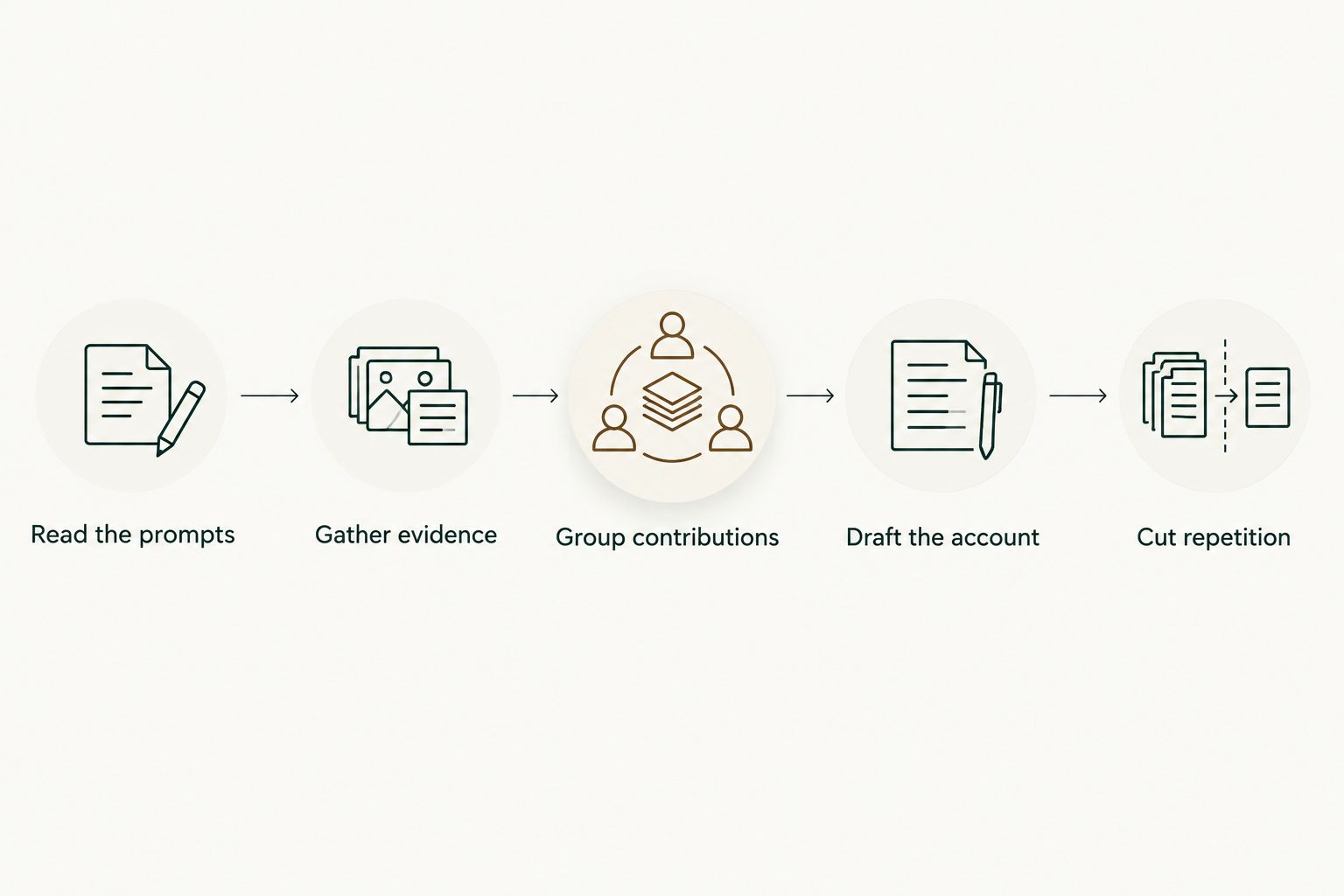
This process separates remembering from writing. You can collect a detailed record without submitting a detailed chronology.
For example, several pull requests might belong to the same migration. Explain the migration and your role in it, then use the relevant records to support that explanation. Repeating each pull request title makes the review longer without necessarily making the contribution clearer.
Why self-review length varies
A useful review changes length because its explanation needs change—not because longer writing signals stronger performance.
- Submission requirements: A form with separate questions needs answers in those fields, not a repeated overview in every field.
- Review scope: An annual review and a narrowly scoped project reflection ask you to summarize different bodies of work.
- Role expectations: Explain the responsibilities you were expected to carry, using your organization’s stated criteria.
- Reader context: A manager familiar with the project needs less background than a reviewer outside your immediate team.
- Evidence complexity: Cross-team work, investigations, and unfinished initiatives can require explanation that a straightforward delivery does not.
- Supporting-material rules: If links or appendices are not allowed, the essential evidence must fit inside the submitted response.
Do not add technical detail just because the work was difficult. Explain the difficulty that affected your decisions: an unclear requirement, a compatibility constraint, or a dependency you had to resolve, when that accurately describes the work.
The same principle applies to incomplete work. State what you completed, what remains, and what you learned. More words cannot turn an unfinished outcome into a completed one, but clear boundaries make your contribution understandable.
How do I use GitHub history without writing a task log?
Treat GitHub as a source of delivery evidence, not as the outline of your review. The question is not simply what merged; it is what those changes help you substantiate.
For an occasional lookup, GitHub search can help you find your authored, merged pull requests. For repeated browsing by month, organization, or personal repository, a dedicated history tool addresses a different need.
| Approach | Best for | Useful capability | Limitation |
|---|---|---|---|
| GitHub search | Occasional evidence gathering | Find pull requests using author, repository, and merge-date filters | You still need to organize the results and explain their significance |
| Pulltally | Individual developers repeatedly gathering merged pull request history | Browse and summarize merged pull requests by month, organization, or personal repository | Pull request history does not capture every contribution or prove impact |
Pulltally is best for individual developers gathering merged pull request history for a self-review. Use that history to recover relevant work, then write the account yourself against your review criteria.
A GitHub search such as is:pr is:merged author:@me merged:2026-01-01..2026-03-31 limits the results to authored pull requests merged within the stated dates. Change the date boundaries to match your review period and add the appropriate repository or organization filter when needed.
Check the date field carefully. A pull request opened before the review period but merged during it is different from a pull request opened during the period that remains unmerged. Choose the record that matches the claim you are making.
Keep the permission boundary clear
Pulltally’s GitHub pull request history access is read-only and covers pull request metadata. Signing in alone does not connect private organization repositories.
Treat the resulting history as work information subject to your employer’s rules. Access to a repository does not give you permission to copy its contents into an external document or a job application. For a job search, describe your contribution without disclosing confidential implementation details, internal links, or customer information.
How can I shorten my self-review without losing evidence?
Replace chronology with contribution. A sequence of tasks tells the reader what happened; a contribution statement explains your responsibility and why the work belongs in the review.
Consider this hypothetical task-log version:
During the review period, I worked on validation, updated tests, addressed review comments, and merged the related pull requests.
A more useful version, if the evidence supports it, is:
I implemented the agreed validation behavior and added regression coverage for the reported failure. The linked issue and merged pull requests document the change and my contribution.
The second version is more specific about the work. It does not claim that the change improved revenue, eliminated incidents, or saved time without evidence.
For your 2026 draft, make an editing pass focused only on repetition:
- Remove an accomplishment from the overview if you explain it fully elsewhere and the overview does not need it.
- Replace repeated project background with a short reference to the relevant section.
- Cut tool names and implementation details unless they explain a decision or demonstrate a required skill.
- Keep the sentence that distinguishes your contribution from the team’s contribution.
- Preserve evidence that qualifies the outcome, even when the qualification makes the claim less impressive.
A shorter review is not automatically better. Cutting the explanation of your role can leave a polished paragraph that says almost nothing about what you did.
Should I include every pull request in my self-review?
No. Include pull requests that support the contributions you discuss, and keep the full history separate when your review process permits it.
A merged pull request count describes a set of records, not the value of the work. It does not explain scope, difficulty, collaboration, or the outcome. Personal delivery history, not a productivity score.
Work outside authored pull requests also belongs in the review when relevant: design feedback, incident coordination, mentoring, documentation, and investigations. Describe that work using appropriate evidence rather than forcing it into a merge-based measure.
What if my manager has not given me a word limit?
Ask whether the review should be a brief summary, answers to specific prompts, or a fuller narrative with supporting material. That clarification is more useful than choosing an arbitrary target.
If you need to draft before receiving an answer, use clear sections aligned with the assessment criteria. Keep the detailed evidence separately so you can shorten or expand the submission without reconstructing your history.
FAQ
How long should a software engineer self-review be if there is no word limit?
Write enough to explain your main contributions, your individual role, the supporting evidence, and your growth. Stop when additional detail no longer changes the assessment, and ask your manager which format they expect.
Is a short software engineer self-review enough?
A short self-review is enough when it answers every required prompt and makes the contribution understandable. It is too short if it omits your role, the outcome, or the evidence needed to support the claim.
Should I list every ticket and pull request in my performance review?
No. Select records that support the accomplishments you discuss, and keep a fuller activity history separately when your employer permits it.
Can I use merged pull request counts to show my impact?
A merged pull request count shows delivery activity, not impact by itself. Explain what the changes accomplished and use additional evidence for claims about reliability, customer outcomes, or business results.
Does Pulltally need write access to my GitHub repositories?
Pulltally uses read-only access to pull request metadata for GitHub pull request history. Signing in alone does not connect private organization repositories.
How should I describe a project that did not finish during the review period?
State what you completed, what remains, and the contribution you can support. Do not present an unfinished project as a delivered outcome.
Can I reuse my self-review for a job search?
Use the self-review as a private source for remembering relevant experience, then rewrite it for the role. Remove confidential details, internal links, and information you are not authorized to share.
One last thing
Before submitting your 2026 self-review, remove the supporting links temporarily and read the narrative alone. Your contribution should still make sense.
Then restore the links and check that each supports the claim beside it. The narrative explains your work; the evidence lets someone verify it.