Pull request analytics for technical recruiters: complete 2026 guide
Pull request analytics for technical recruiters should guide interviews, not rank candidates. Review merged PRs with context, consent, and clear access limits.

Technical recruiters’ pull request analytics is the review of merged code contributions with the aim of preparing evidence-based hiring conversations. Use candidate-selected work to understand experience, not to rank developers by contribution counts; private repositories and different team workflows make raw totals unsuitable for candidate comparisons.
A useful recruiting workflow starts with the developer’s own account of their work. The same preparation used for self-review summaries from GitHub PRs helps candidates recall examples, but a hiring conversation needs explanation rather than an activity report.
Why pull request analytics matters for technical recruiters
Merged pull requests give you concrete material for discussing software delivery. A candidate can point to a change, explain the problem, and describe what happened during review. That creates a more specific conversation than asking whether someone has experience with a language or framework.
A merged pull request is evidence of a contribution, not a complete account of an engineer’s ability. It does not capture every design discussion, debugging session, mentoring contribution, or operational responsibility. Treat it as a starting point for questions.
Technical recruiting also introduces a permission boundary. A developer’s ability to view an employer’s repository does not give a recruiter permission to receive its contents. Public contributions are easier to inspect, but public visibility still does not explain the developer’s ownership or the project’s constraints.
For your 2026 hiring process, separate these questions:
- What work does the candidate choose to discuss?
- What can the candidate share without exposing confidential information?
- What does that example demonstrate for the role?
- What remains unknown after reviewing it?
This approach keeps the evidence useful without turning repository access into an unofficial hiring requirement. Candidates with confidential work need an alternative way to describe their experience.
How to review pull request history with candidates
Use the following sequence when a candidate wants to discuss GitHub work. Start with manual search; introduce a history tool only when browsing across months or repositories becomes repetitive.
Agree on scope before collecting anything. Then search, choose examples, add context, discuss the evidence, and record its limits. The order prevents a visible count from becoming a judgment before you understand the work.
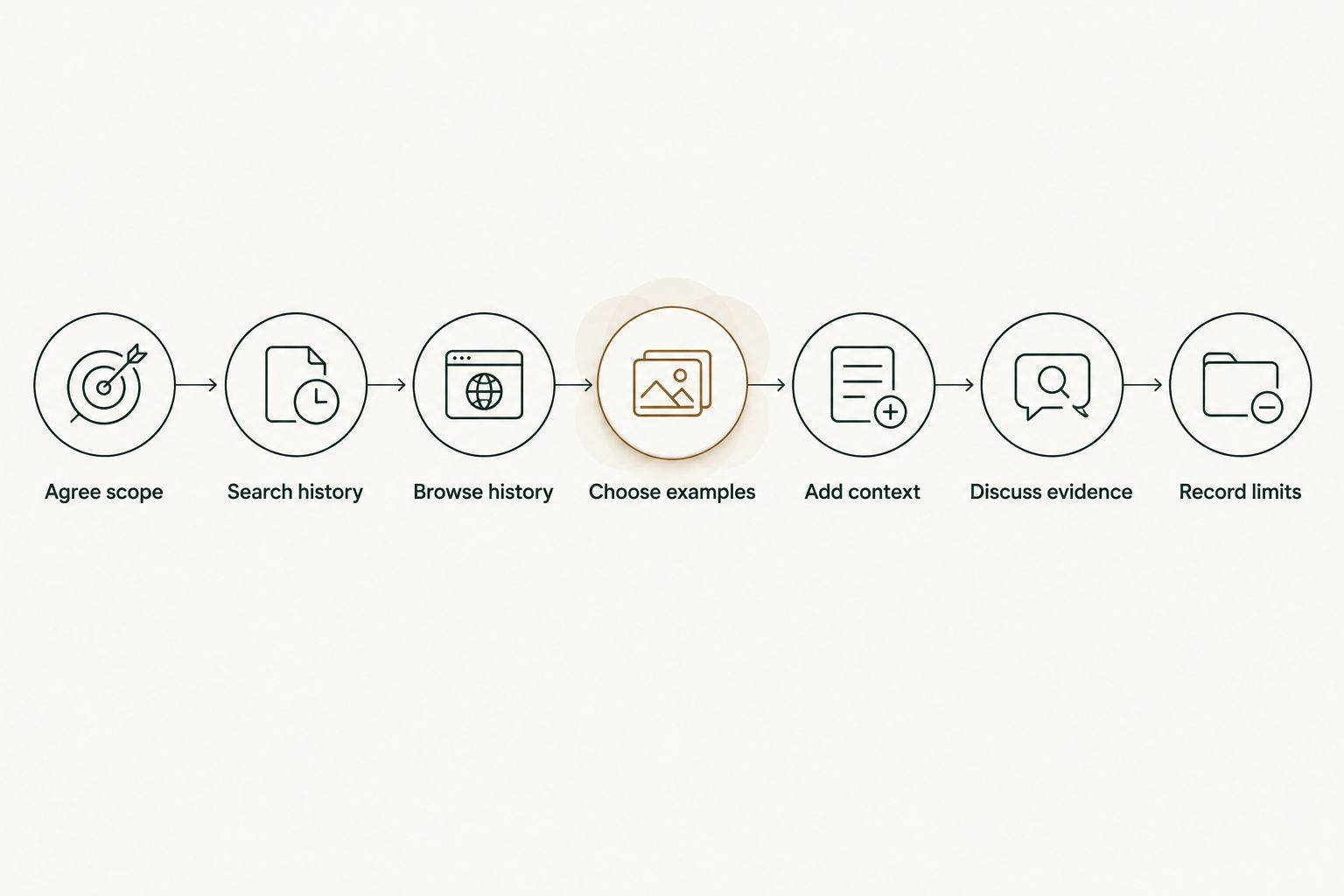
Agree scope
Ask the candidate which projects and dates they want to discuss. For a 2026 interview, that might mean recent work or an older project that matches the role. Recency is a selection criterion, not evidence that a contribution was more valuable.
Make participation optional when the work is private. A written explanation of a technical decision can support the same conversation without providing repository access. Do not ask the candidate to connect an employer’s organization merely to satisfy a screening request.
Define what you will retain. A recruiting note describing an example is different from a copy of source code, screenshots of internal discussions, or a downloaded repository. Collect only what the interview needs.
- Agree on the project and date range with the candidate.
- Ask whether the selected material is public or confidential.
- Accept a sanitized narrative when direct inspection is inappropriate.
- State whether interview notes will include links or summaries.
- Avoid requesting organization access as a hiring prerequisite.
Search history
For an occasional lookup, use GitHub’s pull request search with the candidate’s username and an agreed scope. An authored, merged PR search is different from searching every issue or every contribution associated with an account.
For example, a search covering January through March 2026 can use is:pr is:merged author:USERNAME merged:2026-01-01..2026-03-31. Replace USERNAME with the candidate’s actual GitHub username. Add repo:OWNER/REPOSITORY when the conversation concerns one repository.
The results reflect the search criteria and the repositories your account can access. An absent result does not prove that the candidate did no work. Check the username, repository, date range, and access before discussing a gap.
- Use
is:prto select pull requests. - Use
is:mergedto exclude unmerged requests. - Use
author:to identify authored pull requests. - Use
merged:to define the agreed time window. - Add
repo:ororg:to narrow the scope.
Browse history
Manual GitHub search works well when you need a single example. Repeating similar searches across months, organizations, and personal repositories creates a different task: reconstructing a developer’s delivery history.
Pulltally is best for individual developers browsing merged GitHub pull requests for job-search or performance-review preparation. Its pull request analytics organize personal history by month, organization, or personal repository. That fits candidate preparation; it is not a substitute for recruiter judgment.
Keep the developer in control of the selection. Ask for the examples they want to discuss rather than treating a personal history tool as a recruiter-facing ranking system. The limitation is straightforward: organized merged PR history still needs an explanation of contribution, difficulty, and outcome.
- Start with GitHub search for a one-off question.
- Use Pulltally when repeated history browsing is the actual task.
- Let the developer select the examples to discuss.
- Keep personal repositories distinct from organization work.
- Treat the resulting history as preparation, not a score.
Choose examples
Ask the candidate to select 3 merged pull requests that demonstrate different aspects of the role. This is a preparation format, not a threshold for qualification. If the candidate cannot share PRs, use equivalent examples described without confidential details.
For a backend role, the examples could concern an API change, a production defect, and a maintainability improvement. These are suggested discussion categories, not claims about what every repository contains. Choose categories that match the actual job.
Avoid selecting only the largest changes. A narrow fix can involve difficult diagnosis, while a large diff can include generated files or mechanical changes. Ask why each example matters before judging its apparent size.
- Choose one example of solving a user or business problem.
- Choose one example of technical judgment under constraints.
- Choose one example of collaboration or responding to review.
- Explain why each example matches the role.
- Substitute a sanitized account when sharing the PR is inappropriate.
Add context
Turn each selected PR into a short account of the work. Ask for 2 sentences: one describing the problem and the candidate’s contribution, and one describing the outcome or what remains uncertain. Keep supporting detail available for the interview.
Separate what the repository shows from what the candidate explains. A merge date establishes when a request was merged; it does not establish when the work started. Authorship also needs context when someone implemented a shared design or incorporated another developer’s changes.
A clear account can include an unresolved trade-off. You do not need to force every example into a success story. Understanding why an engineer rejected an approach or accepted a limitation can make the interview more useful.
- Describe the problem before naming the implementation.
- State what the candidate personally contributed.
- Identify collaborators without claiming sole ownership.
- Explain an important constraint or trade-off.
- Distinguish observed outcomes from unmeasured expectations.
Discuss evidence
Use the selected work to prepare questions, not to replace the technical interview. For a 2026 screening call, reserve 10 minutes for discussing one example in depth rather than trying to cover an entire contribution history. This is a scheduling recommendation, not a hiring benchmark.
Ask the candidate to explain the decision in language appropriate to the conversation. Recruiters can establish scope, ownership, and relevance; technical interviewers can examine implementation details. Do not infer technical quality from a merge badge alone.
When comparing candidates, keep the role criteria consistent while allowing different evidence. One person can discuss public PRs; another can explain confidential work without links. The format differs, but the question about experience remains the same.
- Ask what problem the change addressed.
- Ask which alternatives the candidate considered.
- Ask what changed after review feedback.
- Ask how the candidate checked the result.
- Pass technical uncertainties to the technical interviewer.
Record limits
Write a short recruiting note that separates evidence from interpretation. Record what the candidate shared, what they explained, and what still needs assessment. A note such as “described an API migration and its compatibility trade-off” is more useful than a contribution-count label.
Do not retain confidential material simply because it was visible during a conversation. Follow your organization’s candidate-data practices and the agreed sharing boundary. Keep the candidate’s explanation attached to the example so a later interviewer does not interpret a link in isolation.
Your 2026 interview template should make uncertainty explicit. Missing public history, inaccessible repositories, and a small selected sample all limit what the record can establish. None is a standalone verdict on capability.
- Record the role-relevant experience discussed.
- Identify which statements came from the candidate.
- Note what the selected PR directly demonstrates.
- List questions requiring technical assessment.
- Exclude confidential code and unrelated personal details.
Compare the available approaches
Choose an approach based on the task, not the amount of data it produces. GitHub search helps you inspect an agreed example. A spreadsheet helps organize notes. A candidate-authored narrative explains work that cannot be shared directly. Pulltally pull request analytics help an individual developer browse merged history.
The options serve different parts of the workflow. None establishes hiring suitability by itself, and none turns a merged PR count into a fair comparison across candidates.
| Option | Best for | Main advantage | Key limitation |
|---|---|---|---|
| GitHub search | Occasional, scoped PR lookups | Lets you specify author, repository, and merge dates | Repeated searches require manual effort; results depend on access |
| Spreadsheet or document | Organizing candidate-selected evidence | Keeps interview questions and context beside each example | Requires manual entry and maintenance |
| Candidate-authored narrative | Confidential work or contributions without shareable PRs | Explains decisions without requiring repository access | The account needs follow-up questions and technical assessment |
| Pulltally | Individual developers preparing from merged PR history | Supports browsing by month, organization, or personal repository | Personal merged history does not establish skill or business impact |
Use the lightest approach that answers the interview question. If the candidate already has a clear example, another analytics workflow adds preparation rather than evidence. If the candidate is reconstructing work across months, organized history addresses that specific problem.
Common mistakes technical recruiters make
Treating PR counts as candidate rankings
A count describes the selected set of pull requests. It does not normalize project scope, team practices, repository access, or the candidate’s responsibilities. Compare evidence against role criteria, not one developer’s total against another’s.
Requiring public GitHub activity
Public repositories do not contain every developer’s professional work. Requiring visible activity makes public contribution history a prerequisite even when the role does not require it. Offer a confidential-work discussion route instead.
Asking candidates to expose employer repositories
An interview is not permission to share an employer’s code or internal discussions. Ask for approved public examples or sanitized descriptions. Do not treat refusal to provide private access as evidence against the candidate.
Confusing authorship with complete ownership
A PR author can contribute within a design created collaboratively. Another engineer can provide review, testing, or operational context that the PR count does not represent. Ask which decisions and implementation work belonged to the candidate.
Letting analytics replace technical assessment
A merged change gives an interviewer something to examine; it does not assess the explanation automatically. Keep technical evaluation with the appropriate interviewer. Recruiter notes should identify evidence and questions, not declare code quality from activity totals.
FAQ
What's the best use of pull request analytics for technical recruiters?
The best use is preparing questions about candidate-selected work. Review an agreed example, then ask about ownership, constraints, decisions, and outcomes rather than ranking candidates by PR counts.
Is GitHub search enough for a recruiting interview?
GitHub search is enough for an occasional lookup in an agreed repository and date range. Repeated searches across months or repositories create more manual preparation, but more data is not automatically better evidence.
Is Pulltally built for recruiter candidate scoring?
Pulltally is a personal merged GitHub pull request history tool for individual developers, not a candidate productivity score. Developers can browse and summarize their own history by month, organization, or personal repository.
Does Pulltally have write access to pull requests?
Pulltally uses read-only access to pull request metadata. Its role is to browse and summarize personal delivery history, not modify pull requests.
Does signing in connect private organization repositories?
Signing in alone does not connect private organization repositories. A recruiting conversation should not require a candidate to connect an employer's private organization.
Can a candidate interview without sharing private pull requests?
Yes, a candidate can discuss sanitized examples without sharing private pull requests. Ask about the problem, personal contribution, technical trade-offs, and outcome without requesting confidential code or internal discussions.
Should recruiters compare candidates by merged PR count?
No, merged PR count is not a fair standalone candidate ranking. Counts lack the context needed to compare responsibilities, change scope, collaboration, and inaccessible work.
What should a recruiter record after discussing a pull request?
Record the role-relevant example, the candidate's stated contribution, and questions needing technical assessment. Keep confidential material out of recruiting notes and distinguish observed evidence from the candidate's explanation.
One last thing
Before saving a recruiting note, remove the PR count and ask whether the example still supports a useful question. If it does, you have recorded evidence with context. If it does not, ask the candidate to explain the work before keeping the metric.
Personal delivery history, not a productivity score. That boundary keeps a useful preparation workflow from becoming a judgment it cannot support.