Can Pull Tally help me prepare talking points for a job interview?
Can Pull Tally help me prepare talking points for a job interview? Yes—use merged GitHub PR history to find examples, check context, and protect details.

Yes—you can use merged GitHub pull request history to recover concrete examples for job interview talking points, especially when you have forgotten what shipped or when. The history gives you a starting point, not a finished interview answer: you still need to explain your decisions, your contribution, and any outcome you can verify.
Can Pull Tally help me prepare talking points for a job interview?
Yes. Its role is to help you browse and summarize merged GitHub pull requests so you can identify work worth discussing. Whether that replaces manual searching depends on how often you revisit your history.
| Approach | Best for | What it helps you do | Limitation |
|---|---|---|---|
| Pull Tally | Individual developers revisiting work across months or repository contexts | Browse and summarize merged PRs by month, organization, or personal repository | Merged history still needs your explanation of decisions and outcomes |
| GitHub search | An occasional lookup when you remember the repository or topic | Find a specific pull request and inspect its context | Repeating searches across separate periods requires manual work |
Pull Tally is best for individual developers who need to replace repeated GitHub searches with browsable merged pull request history. Neither approach turns a merged PR into proof that you owned an entire project or delivered a particular business result.
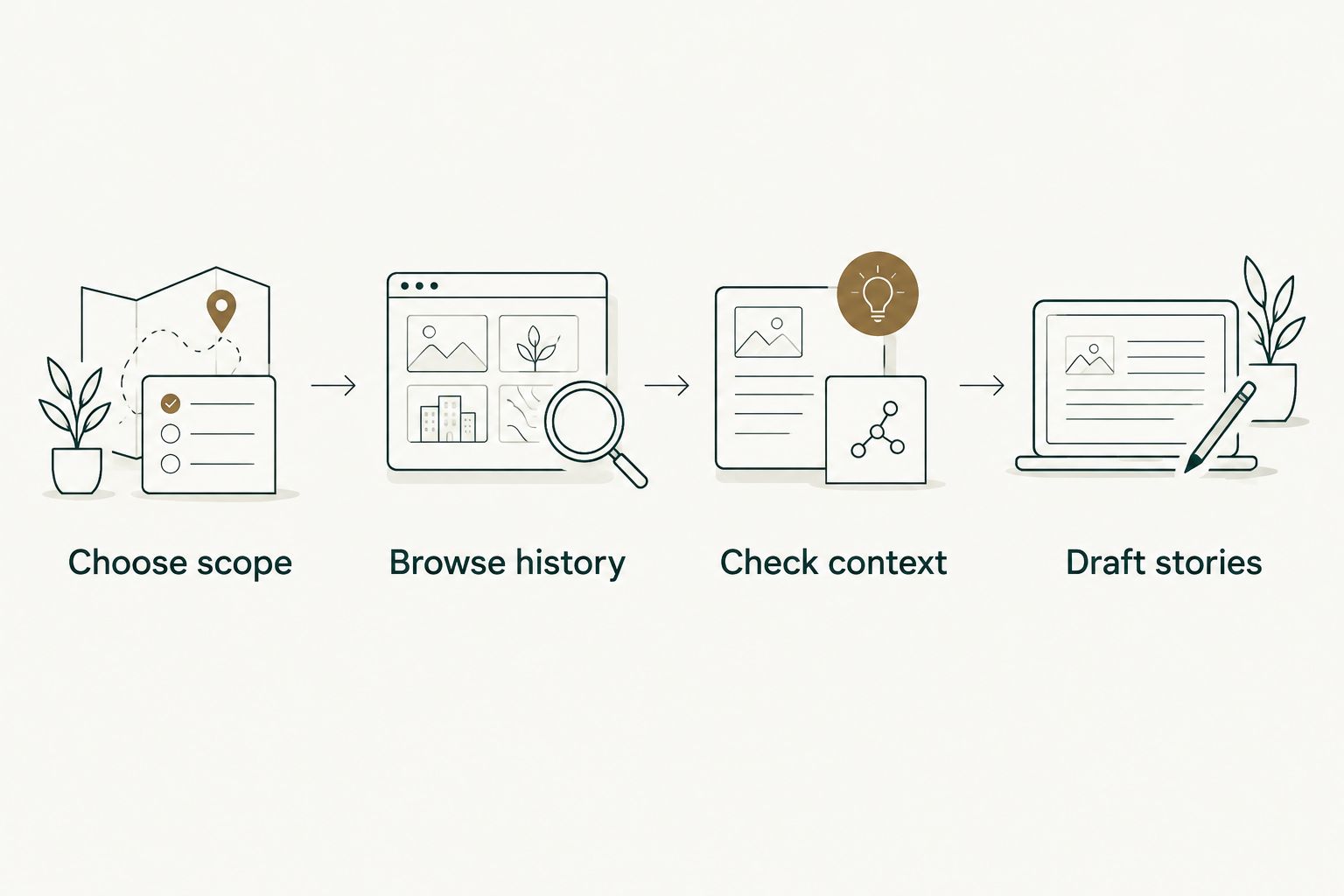
For interview preparation, follow this sequence:
- Choose scope. Start with a relevant period, organization, or personal repository rather than everything you have ever merged.
- Browse history. Look for changes connected to the role you want, not just changes with memorable titles.
- Check context. Revisit the underlying work to confirm the problem, your contribution, and the reason for the approach.
- Draft stories. Turn the strongest examples into concise explanations of decisions, trade-offs, and verified outcomes.
Why this matters
An interview answer needs more than a task title. You need enough detail to explain what was difficult, what you decided, and where your responsibility began and ended.
For a 2026 interview, your strongest example does not have to be your latest merge. An older change that you understand clearly is a better starting point than a recent change whose context you cannot explain. Use the history to recover candidates, then judge them against the question you expect to answer.
The distinction matters for trust, too. Personal delivery history, not a productivity score. A tally describes merged work; it does not measure engineering judgment, collaboration, or the value of a contribution.
How do you choose pull requests worth discussing?
Start with the job description and the questions you expect. If the role emphasizes debugging, search your memory and history for a problem you investigated; if it emphasizes system design, look for a change involving a meaningful technical choice.
Do not select examples solely because they touched many files. Choose work you can explain without filling gaps with assumptions.
Look for a decision, not just an activity
A pull request titled as a cleanup can contain a useful discussion about compatibility or maintenance. Conversely, a large feature PR can leave you with little to say if your contribution was narrow and you do not understand the surrounding decisions.
Ask yourself:
- What problem made this change necessary?
- What did I personally investigate, implement, or clarify?
- What alternative did I consider, and why did I reject it?
- What evidence tells me the change worked?
- What would I handle differently now?
These are selection questions, not claims that every PR records those details. If the history does not answer them, supplement it with your own reliable notes or choose a different example.
Build a small, distinct set
Prepare 3 stories as a starting exercise: one about a technical decision, one about diagnosing a problem, and one about working through feedback. This is a preparation structure, not an interview requirement.
Avoid making every story about the same project unless that project genuinely demonstrates different decisions. You want examples you can adapt without forcing an unrelated answer into the conversation.
A small set also makes verification manageable. You can revisit the relevant changes and separate what you remember from what the record actually supports.
How do you turn a merged PR into a talking point?
A merged pull request establishes that a change entered the target branch. Your interview answer must explain why the change mattered and what you contributed.
Use the following prompts to draft a story. Keep a private evidence note separate from the version you plan to say aloud.
| Story element | What to write | What to verify |
|---|---|---|
| Problem | The behavior or constraint you needed to address | That the problem was real, not inferred from the title |
| Contribution | The work you personally performed | Where your responsibility differed from teammates' work |
| Decision | The approach you chose and the trade-off involved | That you can explain the alternative fairly |
| Outcome | What changed after the work | Whether the record supports the result you describe |
| Reflection | What you learned or would change | That the lesson follows from the actual experience |
Draft the short version first
Write the problem and your contribution in 2 sentences before adding detail. That constraint helps expose a story that is really a list of implementation tasks.
Then rehearse a 90-second version as a practice exercise. Leave room for follow-up questions rather than reciting every file, review comment, and implementation step.
For example, a hypothetical developer might describe investigating inconsistent validation, comparing possible fixes, and implementing a shared check. That is a usable outline only if it matches the developer's actual work; it is not evidence of a particular result.
Keep the outcome narrower than the claim
If you can verify only that the change merged and a test covered the reported behavior, say that. Do not convert those facts into an unsupported claim about revenue, customer retention, or time saved.
A precise technical outcome is enough to support a useful discussion. You can explain what the test demonstrates, what it does not demonstrate, and what additional evidence you would want.
How should you filter your history for a specific interview?
Use the available month, organization, and personal-repository views to narrow your starting point. The right scope is the one that helps you recover relevant work without confusing separate projects.
Suppose you are preparing in June 2026 and want to revisit work from March 2026. Start with that period, identify candidate changes, and then check whether their underlying work actually belongs in the story you plan to tell.
A merge date is an event date, not a complete project timeline. Work can begin before the month in which its pull request merges, so avoid presenting a monthly tally as a record of when every task started or ended.
For organization work, keep the story tied to the correct team and project context. For a personal repository, explain your own constraints and choices without presenting the work as customer or employer experience.
Use filters to find evidence, not to manufacture a career narrative. If an example does not fit the role, leave it out even when it appears prominently in your history.
Why interview usefulness varies
The same merged-history view will not produce equally useful talking points for every developer. Its usefulness depends on the work recorded there and the questions you need to answer.
- Relevant repository context. Work in the organization or personal repository you select must relate to a topic you can discuss.
- Recoverable detail. A title alone does not explain the problem, decision, or result behind a change.
- Clear personal contribution. Shared work requires you to distinguish your part from the team's result.
- Verified outcomes. A merge confirms a repository event; claims about impact need separate support.
- Disclosure limits. A technically strong story still needs an interview-safe version if it involves confidential work.
These factors also explain when manual GitHub search is sufficient. If you already know the exact example you want, finding that PR directly is a reasonable next step. Use a broader history view when recalling and sorting the work is the repetitive part.
What data does the tool access?
Pull Tally uses read-only access to pull request metadata to support browsing and summarizing your merged PR history. Read-only access does not grant permission to modify your repositories.
Signing in alone does not connect private organization repositories. Treat authentication and access to private organization work as separate questions when deciding what history to connect.
Before using private work for preparation, check your employer's rules and the permissions presented during connection. Read-only access addresses modification permissions; it does not replace your responsibility to handle confidential information appropriately.
You also do not need to share a private PR link with an interviewer to discuss a contribution. Prepare a version that explains the problem and your reasoning without exposing restricted details.
Can I discuss private repository work in an interview?
You can discuss work only within the confidentiality obligations that apply to you. Repository access does not grant permission to disclose code, customer information, internal discussions, or unreleased plans.
Describe the technical constraint and your decision at an appropriate level of abstraction. If the example depends on revealing protected details to make sense, choose another story rather than trying to work around the restriction.
Does a high merged PR count make a stronger interview answer?
A high merged PR count does not establish stronger engineering judgment or greater impact. The count does not explain how work was divided, how difficult the decisions were, or what happened after merging.
Use a tally to locate a period of work and prompt your memory. Build the answer around a defensible contribution, not around a ranking of yourself against other developers.
Keep an evidence note for the next interview
After preparing a story, save a short private note with the problem, your contribution, the evidence you checked, and any disclosure limits. Keep repository references only where your organization's rules allow them.
A brag document for software engineers gives you a place to retain that context between interviews and performance reviews. The useful part is not a longer list of accomplishments; it is preserving the reasoning that a PR title leaves out.
For your next 2026 preparation session, revisit the note before searching again. Confirm that the facts still support the wording and that you can answer likely follow-up questions without relying on confidential material.
FAQ
Can Pull Tally write my job interview answers for me?
Use Pull Tally to browse and summarize merged GitHub pull request history, then write the interview answer yourself. You need to supply your reasoning, distinguish your contribution, and verify the outcome.
What's the best way to start preparing interview stories from GitHub?
Start with a relevant period or repository and select changes you can explain clearly. Check the problem, your contribution, the technical decision, and the evidence behind the outcome.
Is a merged pull request proof of business impact?
A merged pull request is not proof of business impact. It records a merged change; claims about customer or business results require separate evidence.
Does signing in connect my private organization repositories?
Signing in alone does not connect private organization repositories. Read the permissions presented when deciding whether to connect private organization history.
Can the tool change my GitHub repositories?
The access described is read-only access to pull request metadata, not permission to modify repositories. You should still review permissions and follow your organization's rules for private work.
Should I use only work merged in 2026 for a 2026 interview?
You do not need to limit a 2026 interview to work merged in 2026. Choose relevant examples you can explain accurately, and make their timing clear.
One last thing
Before rehearsing a story, write down the follow-up question you would least like an interviewer to ask. Then check whether your evidence and understanding let you answer it honestly.
That question exposes the boundary between remembering a merge and understanding a contribution. Choose the story you can defend, not the PR that looks most impressive in a list.